
It is the most common question after a few weeks with a sports watch: the app reports poor recovery, but the legs feel light, the head is clear, training goes well. Or the reverse: the watch celebrates a green night and you feel run over. So whom to believe? The honest answer: both, but not in equal parts and not the same way in every situation.
Why the two diverge at all
Watch and feeling contradict each other because they do not measure the same thing. The watch reads last night’s autonomic nervous system: HRV, heart rate, sleep architecture. The morning feeling is a combined report from muscles, head and mood, coloured by coffee, anticipation and stress. Both are real signals with different time horizons: the night can have been poor while the muscles have long recovered, and the body can carry residual load that does not yet feel like anything. A divergence is therefore not a system error; it is information about the difference between the two measurements.
Rule out the measurement errors first
Before a poor night reading gets interpreted, the checklist deserves a pass. If the watch sat loose or on the wrist bone, it measured poorly. Evening alcohol reliably suppresses HRV, even in small amounts, and says nothing about your fitness. A late heavy meal or an intense session shortly before sleep keeps the system at operating temperature through the night. And a starting infection often suppresses the values one or two days before the throat scratches. If any of these apply, the reading is explained and the day is no longer a riddle.
What research says about the feeling
Whoever believes the feeling is the unscientific part reads the literature backwards. A widely cited systematic review concluded that honestly collected self-reports respond to training load more sensitively and consistently than the common objective single measures. The feeling is a highly integrated sensor; it bundles things no watch sees: motivation, muscle state, life situation. Its weak point is different: it can be overruled, by ambition, habit and race days. Exactly there, at systematic self-deception, the watch is incorruptible.
The everyday rule: day by feeling, week by trend
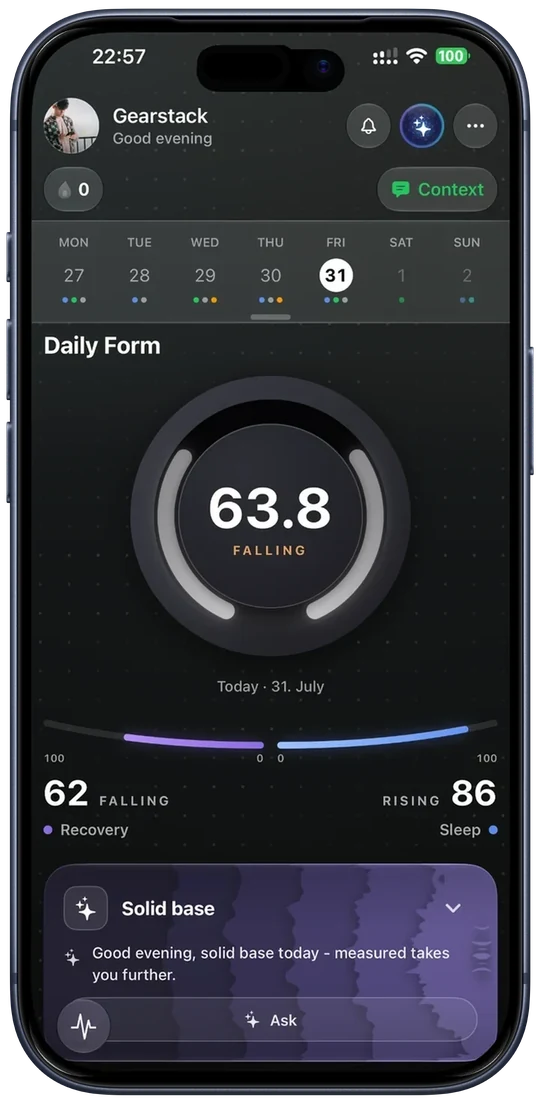
From both follows a simple division of labour. For today’s decision the feeling has the first word: if you feel good while the watch grumbles once, train, perhaps one notch more controlled, and observe. For the week the trend rules: if the watch reports suppressed values against your normal range three or four days in a row, take it seriously even if everything feels fine, because exactly this silent residual load is what the feeling overlooks most reliably. A readiness app like Gearstack makes this division explicit: it shows the trend against your own baseline and asks how you feel, so neither source governs alone.
When neither decides, but the doctor does
One boundary remains. If suppressed values persist for one or two weeks and combine with symptoms, unusual exhaustion, palpitations, chest pressure, shortness of breath or an infection that will not fade, then it is no longer a question of watch versus feeling. Then the question belongs in a waiting room. The watch is a wellness tool and replaces no examination; its best service in such a case is that its history tells the doctor a more precise story than memory would.
Common questions
- Should I skip training on a red recovery score?
- On a single red morning without symptoms: no, but train more controlled and pay attention. On several suppressed days in a row: reduce volume or intensity even if you feel good. With symptoms: rest.
- Why does the watch show poor values after subjectively good sleep?
- Usually one of four reasons: alcohol or a late meal, a hard session the evening before, a starting infection, or simply a sloppy reading from a loose fit. Check this list first, interpret second.
- Can I trust my feeling if I am ambitious?
- For the daily feeling yes, for the weekly picture only partly: ambition overrules the feeling systematically in one direction. That is exactly what the data trend is for; it reports the silent overload that still feels fine.
Sources
Gearstack Health
Your numbers in context
Gearstack Health turns HRV, sleep and training into a daily readiness view with clear next steps.
Gearstack Health is a wellness and prevention product, not a medical device. This text does not replace medical diagnosis, treatment or emergency care.
AI-assisted, reviewed by Kristijan Bezjak, founder of Gearstack.