Few numbers are chased as hard as deep sleep, and it is the least certain figure in your sleep report. This guide puts a normal share in context, explains how well your watch can know it at all, and points at what you can actually change.
What deep sleep is
Deep sleep is the phase with the slowest brain waves, where you are hardest to wake. Heart rate and blood pressure fall, muscles relax, and the body does a large part of its repair work. Among the sleep phases it is the one most closely tied to the feeling of actually being rested in the morning. That is why people react more emotionally to this number than to anything else in a sleep report.
What counts as normal
In adults the deep sleep share typically sits between thirteen and twenty-three percent of sleep time. On seven hours that is roughly one to one and a half hours. The strongest single factor is age: the share peaks in youth and declines noticeably across the decades. A fifty-year-old with forty minutes of deep sleep is unremarkable, a twenty-year-old with the same is less so. There is no target that applies to everyone, only a range that depends on age.
Your watch estimates, it does not measure
This is where most arguments should end. Sleep stages are determined in a lab from brain activity. A watch has no access to that. It infers the likely stage from movement, heart rate and its variability. For telling sleep from wakefulness that works well. For splitting sleep into deep, light and REM it is a reasoned estimate with considerable uncertainty. Use the value as a trend across weeks, not as a measurement of one night.
The first half of the night carries it
Deep sleep is not spread evenly. Most of it falls in the first two to three hours after falling asleep, after which its share per cycle declines while REM increases. Practically that means going to bed late and rising at the same time mostly costs you REM. Lying awake in the middle of the night costs deep sleep instead. And disturbing the early hours, through a late meal, alcohol or heat, hits exactly the window in which deep sleep is produced.
What reliably reduces it
Four things act on almost everyone. Alcohol first appears to help you fall asleep and then breaks up the second half of the night. An overly warm bedroom prevents the drop in core body temperature that initiates deep sleep. Late, intense exertion keeps the system elevated for hours. Irregular bedtimes shift the internal rhythm so the deep sleep windows no longer line up with time in bed. Those are also exactly the four levers you can move.
Why a target is the wrong idea
Deep sleep cannot be trained directly. You can only create the conditions under which your body takes it, and it regulates the amount by need. After several short nights it catches up on deep sleep first, not REM. Chasing a target number and developing anxiety about sleep makes the outcome worse. The better questions are whether your weekly average stays stable and whether you wake at roughly the same time without an alarm. Both say more than last night’s minute count.
Common questions
- I only get thirty minutes of deep sleep. Is that bad?
- For a single night it says little, precisely because the estimate is uncertain. Only if your weekly average sits far below your own previous level and you feel exhausted during the day is it worth working on sleep timing, room temperature and alcohol.
- Why does my watch show different numbers than another app?
- Because every system uses its own rules to infer stages from heart rate and movement. The numbers are not comparable across vendors. Within the same source the trend is still useful.
- Does going to bed earlier increase deep sleep?
- Often yes, because deep sleep is produced mostly in the early hours and those then do not fall into a window where your body already wants to wake. More important than one early night, though, is keeping the time consistent.
Sources
Gearstack Health
Your numbers in context
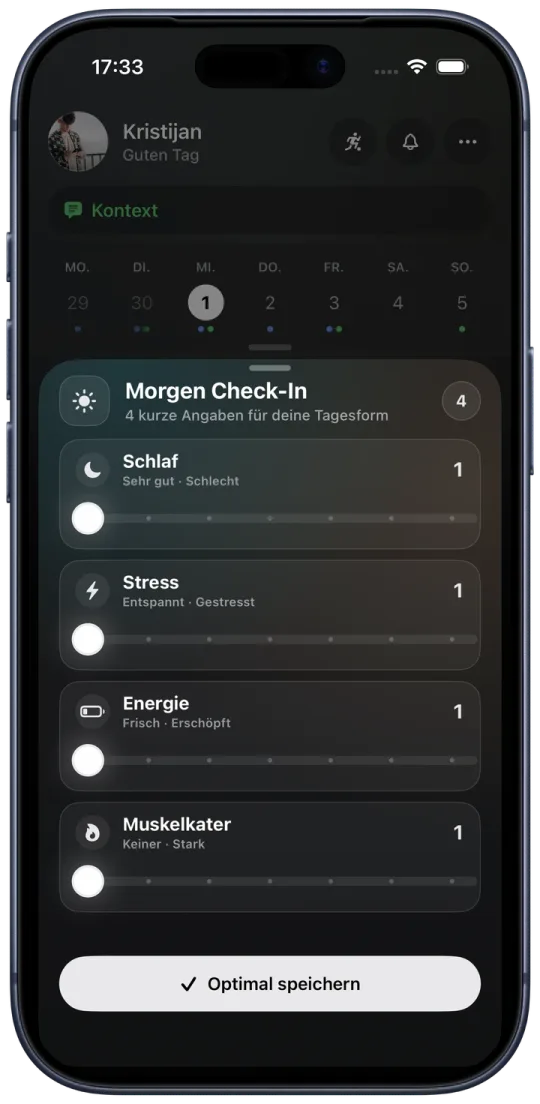
Gearstack Health turns HRV, sleep and training into a daily readiness view with clear next steps.
Gearstack Health is a wellness and prevention product, not a medical device. This text does not replace medical diagnosis, treatment or emergency care.
AI-assisted, reviewed by Kristijan Bezjak, founder of Gearstack.