
Everyone knows the seven to nine hour recommendation, and it still helps almost nobody. It describes a range for a whole population, not your need. This guide covers where the number comes from, how far you may legitimately sit outside it, and how to determine your own value in two weeks.
What is recommended
For adults between eighteen and sixty-four the common recommendation is seven to nine hours a night, and seven to eight from sixty-five. Those figures come from consensus processes by professional bodies that pooled studies on health, performance and accident risk. They are deliberately stated as a range, because need varies considerably between people. Six and ten hours are named as edge values that can still be appropriate for individuals.
Why your need may differ
Individual sleep need is largely inherited. Some people are durably rested on six hours, others need nine for the same output. Both are healthy. It becomes a problem when someone sleeps six but needs eight and bridges the gap with caffeine. That case is the most common one, and it barely registers day to day, because you get used to your own tiredness.
The test without a lab
Take two weeks without an alarm, on holiday or across several free days. Go to bed when tired, get up when you wake by yourself. The first nights run long, because a backlog is being cleared. From around the second week a duration settles that repeats night after night. That is your need, and it is remarkably stable once found.
How to spot too little sleep
Three signs beat any gut feeling. You need markedly more sleep at the weekend than on weekdays, often an hour and a half or more. You fall asleep within five minutes in the evening, which indicates a backlog rather than good sleep. And you get sleepy during quiet moments in the day, at the cinema, in meetings, in the passenger seat. All three together make a clear picture.
Why regularity beats duration
Someone sleeping seven hours every day comes out ahead in most analyses of someone swinging between five and nine for the same average. The internal rhythm aligns to recurring times, not to averages. That makes a stable wake time the single most effective lever: it pulls bedtime along and stabilises the night more than any extra half hour at the weekend.
What a watch can contribute
For duration, and above all for regularity, a watch is good enough. It reliably detects when you slept and when you did not, and that shows how constant your timing really is. For splitting sleep into phases it is far less certain. So use it for the question of whether your pattern is stable, not for whether you got enough deep sleep last night.
Common questions
- Can I catch up on sleep at the weekend?
- Partly. One to two hours offset a short-term backlog, which is documented. What does not work is permanently compensating a week of five-hour nights. Long lie-ins also shift your rhythm, which makes Monday harder.
- I sleep eight hours and am still tired. Why?
- Usually quality rather than quantity: irregular timing, alcohol in the evening, an overly warm room, or unnoticed breathing pauses. If duration and regularity are fine and the tiredness persists for weeks, it belongs with a doctor.
- Are naps a good idea?
- Yes, if they stay short. Twenty minutes in the early afternoon lift alertness without disturbing the night. Longer or later naps take the sleep pressure out of your evening and push falling asleep back.
Sources
Gearstack Health
Your numbers in context
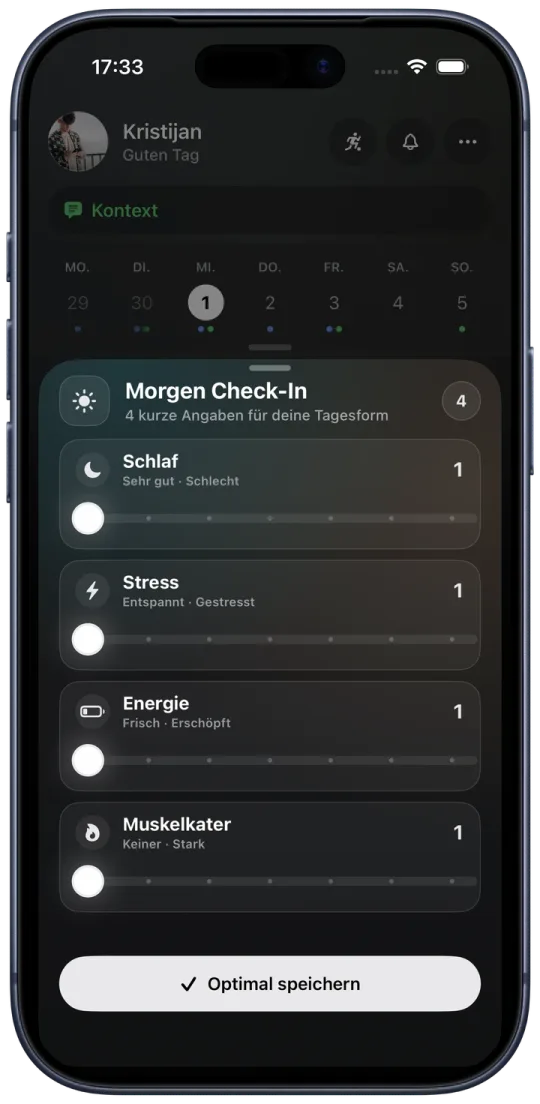
Gearstack Health turns HRV, sleep and training into a daily readiness view with clear next steps.
Gearstack Health is a wellness and prevention product, not a medical device. This text does not replace medical diagnosis, treatment or emergency care.
AI-assisted, reviewed by Kristijan Bezjak, founder of Gearstack.