
Resting heart rate and HRV come from the same signal and still get confused constantly. One is slow and honest, the other sensitive and noisy. It gets interesting when the two point in different directions.
Three numbers, one system
Sleep, resting heart rate and HRV describe the same process from three angles. Sleep is the window in which recovery happens. Resting heart rate shows how much work your circulation still has to do during that window. HRV shows how freely your nervous system can switch between effort and brake while it happens. None of these is the most important one. Only together do they form a picture, because they react at different speeds and with different sensitivity.
Resting heart rate: slow but honest
Overnight resting heart rate moves slowly. It barely reacts to a demanding afternoon, but it responds clearly to things that occupy your system for hours: alcohol, heat, a cold coming on, dehydration, a genuinely hard session. That sluggishness is what makes it valuable. When it sits five beats above normal across several nights, there is almost always something real behind it. False alarms are rare. The price is that it reacts late and hides finer differences.
HRV: sensitive but noisy
HRV is the opposite. It reacts earlier and in finer steps, but it also fluctuates for no reason. Twenty to forty percent deviation from your own average is normal. That is why a single drop rarely says much while a week-long trend says a great deal. Watching only HRV means seeing signals that are not there. Watching only resting heart rate means seeing problems once they have already arrived. The combination cancels out both weaknesses.
Sleep as the link
Both values depend on how you slept, and not only on duration. A short, calm night can produce better numbers than a long, restless one. What matters is how continuous the night was and when it happened. People who sleep on a consistent schedule have steadier values even on slightly fewer hours. Regularity is therefore almost always the more effective lever than the occasional long night.
When the values diverge
Three patterns are worth knowing. Elevated resting heart rate plus lowered HRV usually means real load: a hard session, an infection, alcohol, heat. Both values normal but poor sleep points at circumstances rather than the body, so noise, worries, an unfamiliar bed. Lowered HRV with a completely normal resting heart rate is often just noise and needs no response yet. Conversely, a clearly raised resting heart rate with unremarkable HRV is the pattern most likely to announce an infection.
What that means day to day
In practice: treat resting heart rate as the alarm and HRV as the fine tuning. If resting heart rate climbs clearly across several nights, that is a good reason to reduce volume or take a day off regardless of how you feel. If only HRV drops, it is usually enough to plan a calmer day and look again. And if all three drift downward over weeks without training or illness explaining it, that belongs in a conversation with a doctor.
Common questions
- Which value is the most important?
- None on its own. Resting heart rate has the fewest false alarms, HRV gives the earliest hints, sleep explains both. If you want to follow only one, take overnight resting heart rate because it is the most robust.
- My resting heart rate has been falling for months. Is that good?
- Usually yes, a falling resting heart rate over months typically tracks improving endurance. What would be notable is a very rapid drop within days, or a low resting heart rate together with dizziness or exhaustion. That belongs to a doctor.
- Why is my resting heart rate higher in summer?
- Heat costs circulatory work. The body has to move more blood to the skin to shed temperature, and that raises heart rate at night too. A somewhat higher value in summer is therefore unremarkable, as long as it comes and goes with the heat.
Sources
Gearstack Health
Your numbers in context
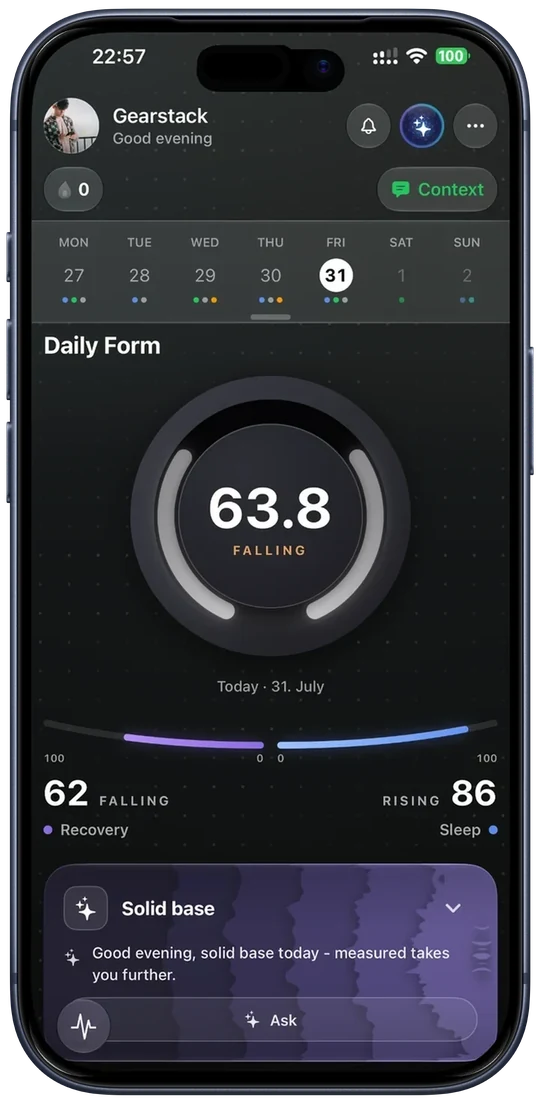
Gearstack Health turns HRV, sleep and training into a daily readiness view with clear next steps.
Gearstack Health is a wellness and prevention product, not a medical device. This text does not replace medical diagnosis, treatment or emergency care.
AI-assisted, reviewed by Kristijan Bezjak, founder of Gearstack.