
A training plan knows the calendar. Your body knows last night, today’s stress and the previous session. When the two do not match, the choice often becomes unnecessarily binary: push through or skip. Three levels are more useful. Push keeps the planned stimulus, Balance adjusts it, and Easy protects movement and recovery. None is a judgement on discipline, and no app can make the whole decision for you.
Readiness supports a decision; it does not start the session
A readiness score summarises measurements, but it cannot know everything. Sensor gaps, an unusual sleep schedule or one HRV deviation can shift the picture. In the other direction, a positive score cannot cancel pain, illness or exceptional life stress. Treat the number as an invitation to a short check: what does my personal trend show, how do I feel, and what stimulus was planned today? That combination turns data into a training choice. With warning symptoms, the question is not which level fits; it is whether to stop and seek medical advice when appropriate.
Why objective and subjective signals belong together
Small randomised studies have compared HRV-guided programmes with predetermined training. In one functional training programme, improvements were similar even though the HRV-guided group completed fewer high-strain sessions. A trial in recreational runners also showed that self-reported stress tolerance can contribute useful information to daily adjustments. The groups were small and the programmes short, so they do not provide a universal formula. The practical lesson is more restrained: personal measurements and honest body awareness may work better together when deciding where to place demanding training.
Push: when the planned stimulus still fits
Push does not automatically mean maximal effort. It means the planned key session still looks appropriate today. There should be no warning symptoms, how you feel should be stable, and the main measurements should sit reasonably close to your personal trend. Start with a normal warm-up and check whether technique, breathing and perceived effort match the plan. If the session feels unexpectedly hard, moving to Balance is not failure; it is good control. Push makes sense when the data, your experience and the training goal point in the same direction.
Balance: keep the stimulus, lower the cost
Balance is the default answer to mixed signals. You still train, but you change one lever: fewer repetitions, shorter intervals, longer recovery, less load, or an easy endurance session instead of speed. Keep technique and movement quality as firm boundaries. This preserves the habit without forcing a doubtful day to become a key stressor. Decide what you will reduce before the session rather than renegotiating every few minutes. A specific adjustment prevents “slightly easier” from quietly turning back into the full programme.
Easy: actively protect recovery
Easy fits when several signals are negative at once: poor sleep, an unfavourable multi-day trend, unusually heavy legs or a sharp rise in everyday load. Depending on the context, it may mean a walk, mobility, very light training or complete rest. The aim is to leave capacity for the next worthwhile session. Fever, clear signs of illness, chest pain, dizziness or breathing difficulty do not call for an Easy workout; they call for stopping. Persistent or concerning symptoms matter more than the plan and should be assessed professionally.
Common questions
- Do I have to cancel a hard session when readiness is low?
- Not automatically. Check whether the score is part of a pattern, how you feel and whether other signals agree. A longer warm-up or a Balance version may fit. Do not use the score to train through illness or unusual symptoms.
- Will choosing Balance often cost me progress?
- An adjustment is not the same as unstructured easy training. If you know the intended stimulus and reduce volume or intensity deliberately, the programme stays purposeful. If recovery remains unusual, review the wider plan rather than only adjusting individual days.
For personal trainers: The other 165 hours of the week
Sources
- High-Intensity Functional Training Guided by Individualized Heart Rate Variability Results in Similar Health and Fitness Improvements as Predetermined Training with Less Effort
- Individually guided training prescription by heart rate variability and self-reported measure of stress tolerance in recreational runners
Gearstack Health
Turn readiness into a clear training choice
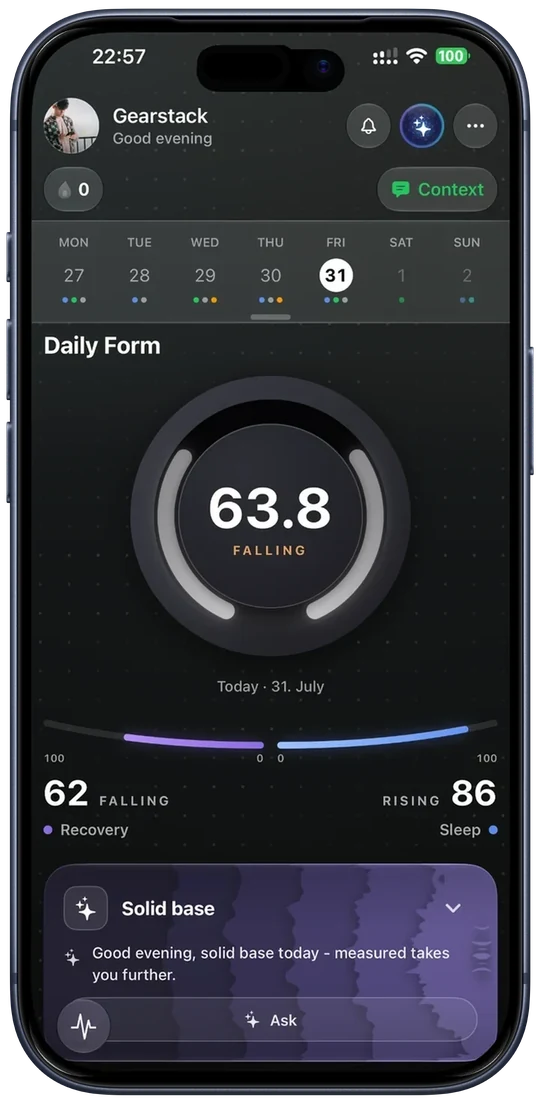
Gearstack connects recovery with the session ahead and explains why Push, Balance or Easy may fit better today.
Gearstack Health is a wellness and prevention product, not a medical device. This text does not replace medical diagnosis, treatment or emergency care.
AI-assisted, reviewed by Kristijan Bezjak, founder of Gearstack.