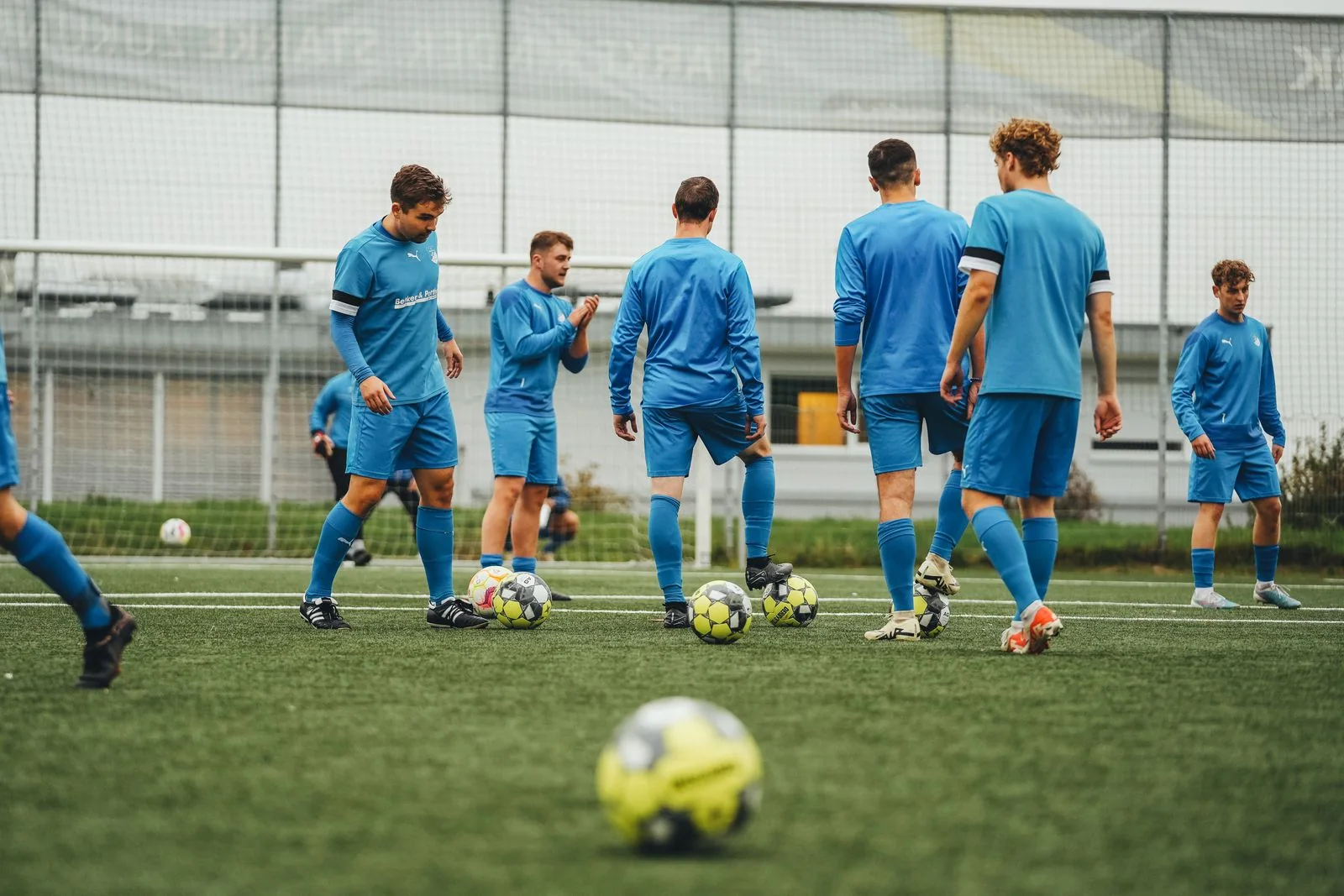
Heart rate variability has made the jump from the lab into everyday football: professional clubs have measured it for years, and every decent sports watch now delivers it for free. Yet hardly any value is misunderstood more often. A low value counts as an alarm, a high one as a free pass, and both are wrong in that generality. What HRV can really do in football training is more precise and more useful.
What HRV measures, in one paragraph
The heart does not beat like a metronome. Between two beats there are sometimes 850, sometimes 920 milliseconds, and exactly this fluctuation is heart rate variability. It is governed by the autonomic nervous system: the recovery branch, the parasympathetic system, makes the rhythm more irregular, the stress branch makes it stiffer. A high HRV during sleep or at rest therefore means the body is switching to recovery and can absorb load. An HRV suppressed for days means something is occupying the organism: training, an infection, poor sleep, exams. HRV does not say what it is. It says that there is something.
Mistake number one: comparing players
Two healthy players in the same squad can sit at 40 and 110 milliseconds, both completely normal. HRV is as individual as shoe size, shaped by genetics, age and fitness. A squad ranking by HRV is therefore pointless and tends to do damage, because it declares the player with genetically low HRV a permanent patient. The only meaningful comparison is each player against his own baseline, the rolling average of the past weeks. If the current value deviates clearly downwards for several days in a row, that is a signal. Everything else is daily noise.
Measure in the morning or let the night measure
Two measurement windows are usable. The classic morning measurement right after waking, lying or sitting, two to three minutes, always the same. Or the automatic overnight measurement of the sports watch, which uses sleep as a natural resting lab. For teams the night measurement is more practical because it works without discipline: the watch measures, the value is there in the morning. Useless, on the other hand, are measurements in between, after coffee, after the stairs, on the bus. HRV reacts to everything, which is why it lives on identical conditions. A value from changing situations is not a measurement but a random number generator.
The pattern coaches should watch for
A single bad morning is allowed, and normal after an intense match: the day after, HRV is almost always suppressed and recovers within 24 to 48 hours. It gets interesting when the recovery fails to appear: HRV below baseline for three or four days, resting heart rate a few beats above the usual at the same time, perhaps shorter sleep on top. This pattern is the classic fingerprint of incomplete recovery, and it usually shows up in the data before the player says anything. The right reaction is unspectacular: defuse the next session for this player, ask, keep watching. If the pattern coincides with a scratchy throat, the player belongs in bed, not on the pitch.
From single value to team: making it work daily
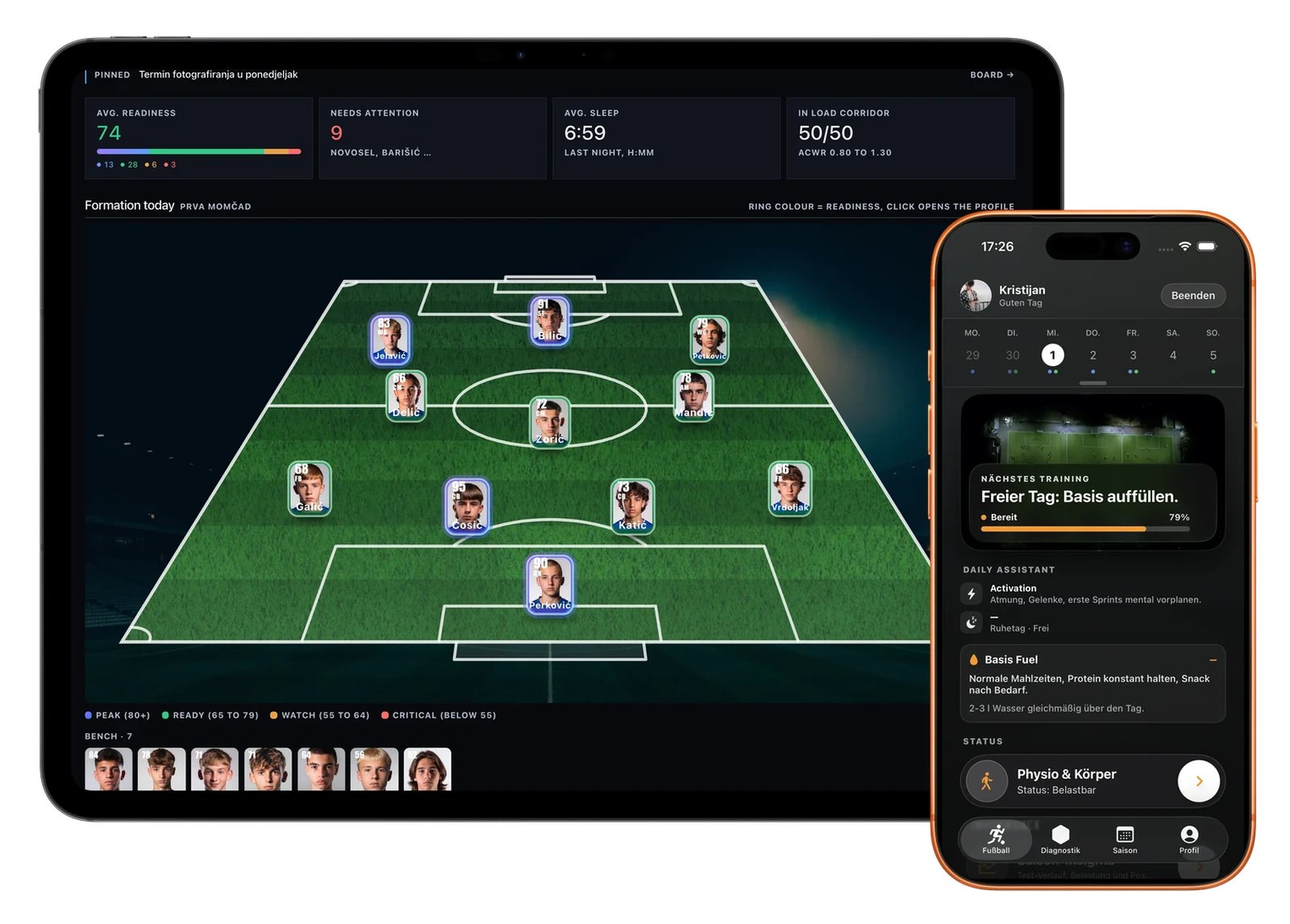
At club level HRV rarely fails on the science and mostly on the logistics: 22 players, different watch brands, and nobody has time to check 22 apps in the morning. It becomes practical when the values converge automatically in one place. In the Gearstack team dashboard every player shares the values from his own watch, the permission is revocable at any time, and the coach sees one page: every player against his own baseline, conspicuous trends first, with load and sleep as context. Whoever wears no watch reports briefly by phone instead. That turns a lab value into a tool that costs half a minute before training.
Common questions
- What is a good HRV for a football player?
- There is no target value. HRV is highly individual; differences of factor two to three between healthy players are normal. Good is a value within the personal normal range of the past weeks, conspicuous is a multi-day deviation downwards.
- How fast does HRV recover after a football match?
- After an intense match HRV is typically suppressed for 24 to 48 hours and then returns to baseline. If it stays down longer, that points to incomplete recovery, a starting infection or training scheduled too densely.
- Is HRV alone enough to manage training?
- No. It is the most robust single value a sports watch delivers, but only the combination with resting heart rate, sleep, perceived state and the training load of the previous days forms a picture. That is why readiness scores bundle several variables.
For clubs: Eleven players, eleven readiness scores
Sources
Gearstack Health
Your numbers in context
Gearstack Health turns HRV, sleep and training into a daily readiness view with clear next steps.
Gearstack Health is a wellness and prevention product, not a medical device. This text does not replace medical diagnosis, treatment or emergency care.
AI-assisted, reviewed by Kristijan Bezjak, founder of Gearstack.