Almost every training zone on your watch rests on a number that was never measured. The 220 minus age formula is convenient, but it scatters so widely that entire zones can land in the wrong place. This guide covers the size of the error, which formula does better, and when a real test is worth it.
Where the formula came from
The 220 minus age rule of thumb dates from the 1970s and was never meant as a precise equation. It emerged as a rough line through existing data and stuck because you can do it in your head. That is exactly what made it durable: it now sits in devices, apps and training plans, although its origin was in no way designed to predict the value of an individual.
How large the error is
Any age-based estimate carries a spread of roughly seven to twelve beats per minute, often more. Concretely: two people of the same age with an estimated maximum of 185 can actually sit at 170 and 200, both entirely healthy. Derive your zones from a value that is ten beats off and you train systematically at the wrong intensity, consistently in the same direction.
The more accurate formula
A synthesis of several hundred studies covering close to twenty thousand people arrived at 208 minus 0.7 times age. That version does better above all for adults over forty, where the old formula systematically underestimates. For a fifty-year-old the old rule gives 170 and the newer one 173; for a seventy-year-old, 150 against 159. The spread between individuals remains, it is simply no longer distorted by an additional age effect.
What determines the real value
Maximum heart rate is largely genetic and says nothing about your fitness. A trained person does not have a higher maximum than an untrained one, they simply sustain more load before getting there. The value declines with age without training holding it back to any meaningful degree. So it is not a target to work on, only a reference point from which zones can be derived.
How to determine it yourself
The most solid value comes from a hard, controlled test, and that belongs only in healthy legs. A common protocol is fifteen minutes of warm-up, then three times three minutes uphill or on a track with rising intensity, the last repetition all out. The highest value recorded is your practical ceiling. A chest strap is mandatory, because optical wrist sensors are least reliable at high intensity with arm movement. Anyone with pre-existing conditions or a long break from training should check with a doctor first.
The detour via threshold
For steering training, maximum heart rate is not the best reference anyway. Zones derived from lactate threshold or threshold pace hit actual load more accurately, because they reflect your training state rather than your genetics. Practically: a thirty-minute test at an evenly hard effort gives you more for planning than any formula. And if you steer by feel and pace regardless, you do not need the maximum at all.
Common questions
- My watch shows 195 in a sprint, the formula says 180. Which is right?
- Probably the watch, provided the value rose plausibly rather than jumping out of nowhere. Optical sensors do produce artefacts at high intensity though. If the value repeats across several hard sessions, it is real and the formula was off.
- Does my maximum heart rate drop when I am untrained?
- No, the maximum barely depends on training state. What changes is the load required to reach it and how quickly you recover afterwards. An untrained person gets there sooner, not higher.
- Do I even need maximum heart rate for zone 2?
- Not necessarily. The common everyday test is whether you can still speak in full sentences while running. For most people that hits the zone better than a percentage band derived from a formula.
Sources
Gearstack Health
Your numbers in context
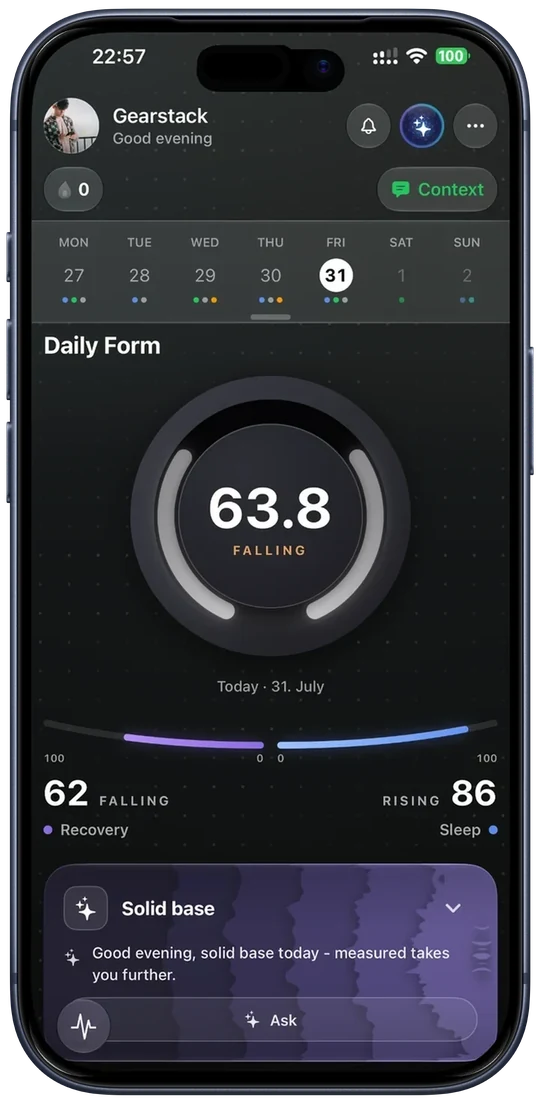
Gearstack Health turns HRV, sleep and training into a daily readiness view with clear next steps.
Gearstack Health is a wellness and prevention product, not a medical device. This text does not replace medical diagnosis, treatment or emergency care.
AI-assisted, reviewed by Kristijan Bezjak, founder of Gearstack.