
At the end of the season the same question always stands: did the boy get better? The honest answer of most clubs consists of memories, and memories are mercilessly partial. They overrate the last match, the prettiest goal and the loudest father. Documented development is the antidote, and it costs less effort than most coaches believe.
Why memory is not an archive
Coaches see their players two or three times a week, and exactly that makes development invisible: whoever sees someone constantly notices slow change last. Add the familiar biases: the latest impression outshines the autumn, striking moments cover quiet consistency, and in same-age comparisons the physically early developer reliably wins. Documentation is not bureaucracy, it is the only way to check one’s own perception against facts on a regular basis.
The four building blocks worth keeping
First, attendance: banal, but half the explanation of almost every development curve. Second, training load, recorded as session RPE, because progress cannot be judged without seeing the work done. Third, physical trend values where watches exist: resting heart rate, HRV and running efficiency averaged over weeks, because they show the engine’s adaptation independent of daily luck. Fourth, the coach’s judgement, deliberately short: two sentences per player per month on technique, game understanding and behaviour. More categories do not mean more insight, they mean the documentation stops in November.
The only fair comparison: the player against himself
Adolescents of the same year group are separated by years of development, physically and cognitively. Every comparison with the boy next to him is therefore a snapshot of maturity, not a verdict on talent or work. What carries meaning is where the player stands today against himself eight weeks ago: does he run further at the same heart rate? Does he absorb higher weekly loads without complaints? That is exactly how the athletic score in the Gearstack dashboard is computed: four weeks against the four before, per player, against his own base. A value around 50 means unchanged; above it, documented progress begins.
The rhythm that survives club life
Documentation never fails on good intentions, it fails on effort. The survivable rhythm looks like this: after every session the players’ load reports arrive automatically, costing the coach nothing. Once a week a look at the squad overview, five minutes, conspicuous cases only. Once a month the two sentences per player, half an hour for the whole squad. And twice a year, in winter and at season’s end, the trend review as the basis for conversations. Everything beyond that is optional and may lapse without the system dying.
What documented development earns the club
The payoff shows in three places. In the parent meeting the development curve replaces the argument about minutes: instead of fighting over the last match, the eight-week trend lies on the table. In squad planning, decisions about development groups and moving players up rest on trajectories instead of tournament moments. And towards the board and sponsors, the youth department can for the first time prove what its work achieves, with a team curve across the season. Whoever can show development does not have to claim it.
Common questions
- How much time does clean development documentation cost per week?
- With automatic load recording, realistically five minutes per week for the squad view plus half an hour per month for the short judgements. The players themselves need under thirty seconds per session.
- From what age is documenting worthwhile?
- Attendance and coach judgement pay off from the foundation years. Load and body data become meaningful from around twelve to thirteen, when training volumes rise and the growth spurt shifts resilience.
- What does not belong in player documentation?
- Diagnoses, weight debates and character grades. What gets documented is attendance, load, trend values and observable behaviour on the pitch. For minors, parental consent and revocable permissions are part of the basic setup.
For clubs: Eleven players, eleven readiness scores
Sources
Gearstack Health
Your numbers in context
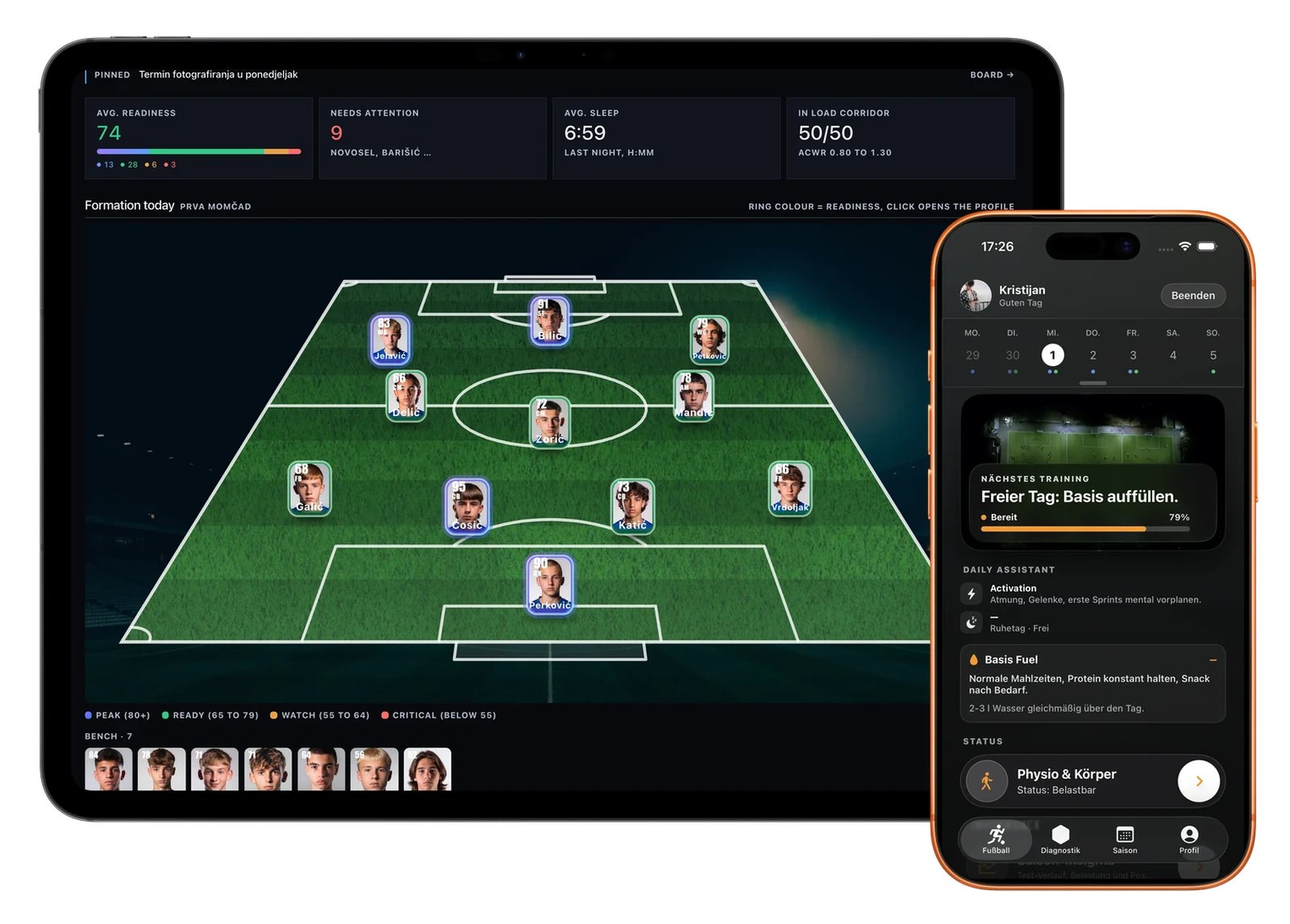
Gearstack Health turns HRV, sleep and training into a daily readiness view with clear next steps.
Gearstack Health is a wellness and prevention product, not a medical device. This text does not replace medical diagnosis, treatment or emergency care.
AI-assisted, reviewed by Kristijan Bezjak, founder of Gearstack.