
Zone 2 sounds precise, but watches and training platforms calculate it with different zone models. Without exercise testing, you do not know your physiological threshold exactly. You can still find a useful range for steady endurance work. The talk test, perceived effort, the heart-rate pattern and several comparable sessions take you there. The result is a practical working hypothesis and does not replace a laboratory finding.
Start by defining what Zone 2 means
In a three-intensity-domain model, steady endurance work usually sits below the first physiological threshold. Many watches instead divide effort into five heart-rate zones and also call their second percentage band Zone 2. Those labels do not necessarily describe the same metabolic range. Age-based formulas only estimate maximal heart rate and can be far from an individual value. Before comparing numbers, check which model your app uses. For the session itself, stable breathing, comfortable speech, and sustainable effort matter more than whether the display shows the exact words “Zone 2.”
Why a fixed percentage is only a starting point
People do not automatically produce the same physiological response at the same percentage of maximal oxygen uptake or heart rate. A controlled study of ten participants compared exercise anchored to individual physiological thresholds with exercise anchored to traditional percentages. Threshold-based prescription reduced variability particularly at higher intensities, while the difference was less clear for moderate work. The small sample cannot supply a universal formula, but it demonstrates the underlying problem: a population percentage can only approximate an individual transition between intensity domains. Treat the watch as a measuring tool rather than the sole definition of intensity.
The talk test provides a useful field check
During steady endurance work, you should be able to speak in complete sentences without needing a marked breath after only a few words. In a small study, 16 physically active adults regulated 30-minute runs using talk-test stages alone. Their physiological responses broadly stayed within the expected training ranges, and the last clearly comfortable speaking stage matched intensities suitable for longer or recovery sessions. That makes the method practical, not infallible. Language, terrain, wind, and daily condition affect the experience, so combine it with moderate perceived effort and a reasonably steady response.
Build your range from three comparable sessions
Choose a flat route, treadmill, or stationary bike and keep the activity and conditions as similar as practical. Start with ten very easy minutes. Then continue for 20 to 40 minutes at a pace where full sentences remain comfortable and effort feels controlled. After settling in, note the typical heart-rate range, how you felt, and the external conditions. Repeat this on at least three ordinary days. The band in which speech and effort remain stable is a better personal starting range than one peak reading. If heart rate gradually rises at the same output, ease off slightly and look beyond the session average.
Readiness and safety still matter more than the zone
Heat, altitude, dehydration, caffeine, poor sleep, illness, stress, and some medicines can change heart rate or perceived effort. Adjust pace on those days instead of forcing a stored number. Zone 2 should feel controlled, but it will not always feel effortless, and heart rate may differ between sports. Stop with chest pain, dizziness, faintness, or unusual breathlessness. Anyone with cardiovascular, lung, or metabolic disease, anyone who is pregnant, or someone returning after a long inactive period should discuss suitable intensity with a medical or qualified exercise professional before progressing.
Common questions
- What heart rate is my Zone 2?
- Without individual testing, there is no exact evidence-based number. Start with the range on your watch, then check it against comfortable speech, moderate effort, and several repeatable sessions. Your personal pattern is more useful than one formula.
- Do I need to slow down whenever heart rate briefly leaves the range?
- A short rise caused by a hill, heat, or measurement noise does not invalidate the session. Focus on its overall character: breathing, speech, and effort should remain controlled. If heart rate stays elevated, easing the pace is sensible.
For clubs: Eleven players, eleven readiness scores
Sources
Gearstack Health
Find the steady range that fits today
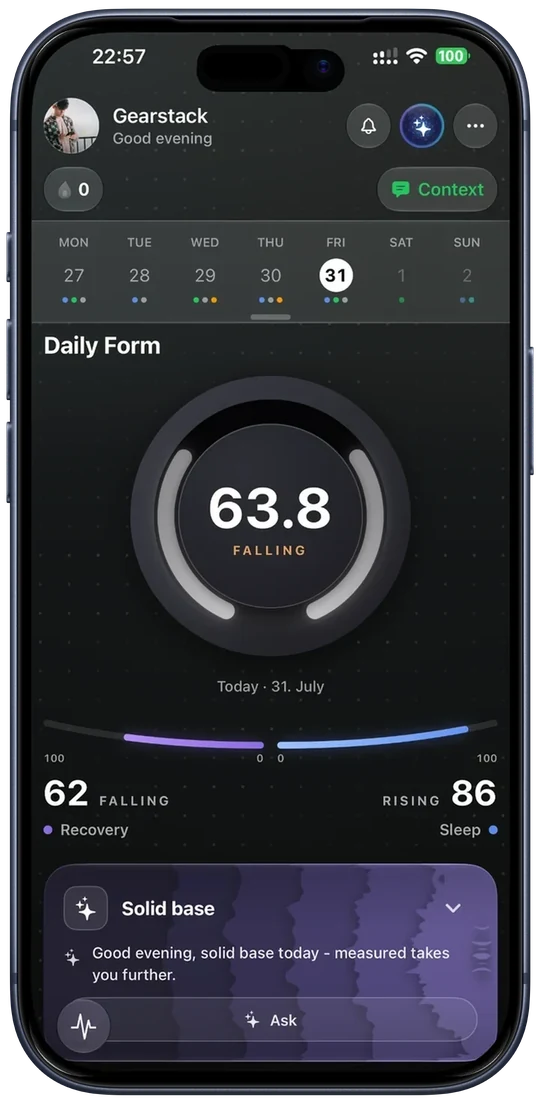
Gearstack connects heart rate, recovery, and training history so you can see whether an easy session is staying easy without turning one fixed number into a rule.
Gearstack Health is a wellness and prevention product, not a medical device. This text does not replace medical diagnosis, treatment or emergency care.
AI-assisted, reviewed by Kristijan Bezjak, founder of Gearstack.