Training management sounds like an academy operation, lactate tests and a staff of sports scientists. The core is more modest and feasible for any club: knowing how much the players train, how they absorb it and what comes next. This guide explains the methods that have proven themselves in amateur and youth football, without a lab and without a full-time hire.
What training management actually means
Training management is the feedback loop between what a coach plans and what the players actually absorb. It consists of three steps that repeat weekly: first, record the load, meaning how much and how intensely the team trained and played. Second, check the response, from daily readiness to complaints. Third, adjust the next week: more, the same or deliberately less. Whoever only plans and never looks back is not managing, he is hoping.
Measuring load: session RPE as the standard tool
The most practical method for clubs comes from Carl Foster and has been validated for over twenty years: session RPE. About ten minutes after the session every player rates its overall effort on a scale from one to ten, and that number is multiplied by the duration in minutes. An intense ninety-minute session rated eight yields 720 points. The value captures running, duels, heat and even mental strain in a single number, works without any device and can be compared across weeks, players and squads. Only two rules matter: the player rates, never the coach, and always at the same moment.
Manage the weekly load, avoid the spikes
Single hard sessions break nobody; what decides is the weekly sum and how it changes. Sports science condenses this into the acute:chronic workload ratio, the ACWR: the current week divided by the average of the past four. If the ratio stays near one, the load is familiar; if it jumps clearly above 1.3 to 1.5, complaints pile up in studies, especially in youth players. For club life the simple version is enough: raise the weekly load by no more than about ten percent above the accustomed level, and return in steps after every break instead of catching up in one week.
The other side: is the player absorbing it?
Load numbers alone are half the loop, because the same week is shrugged off by one player and flattens another. The other half comes from daily recovery values: the sleep of the past nights, heart rate variability and resting heart rate against the personal normal range, plus a short self-report on how legs and head feel. Whoever wears a sports watch delivers the measurements automatically; whoever does not answers four questions on the phone. If readiness drops for several days in a row, the planned session for that player gets defused, whatever the plan says.
Periodisation light: thinking the season in blocks
The third building block is the view beyond the week. No amateur club needs a textbook periodisation model, but every plan should know three blocks: the preparation, where the base grows and weekly load rises in controlled steps; the season, where matches set the rhythm and training mostly maintains instead of builds; and the transitions after breaks, camps and tournament weeks, where most overload happens. Whoever knows a target weekly load per player for each block has the frame in which all single decisions move.
How a club starts without overreaching
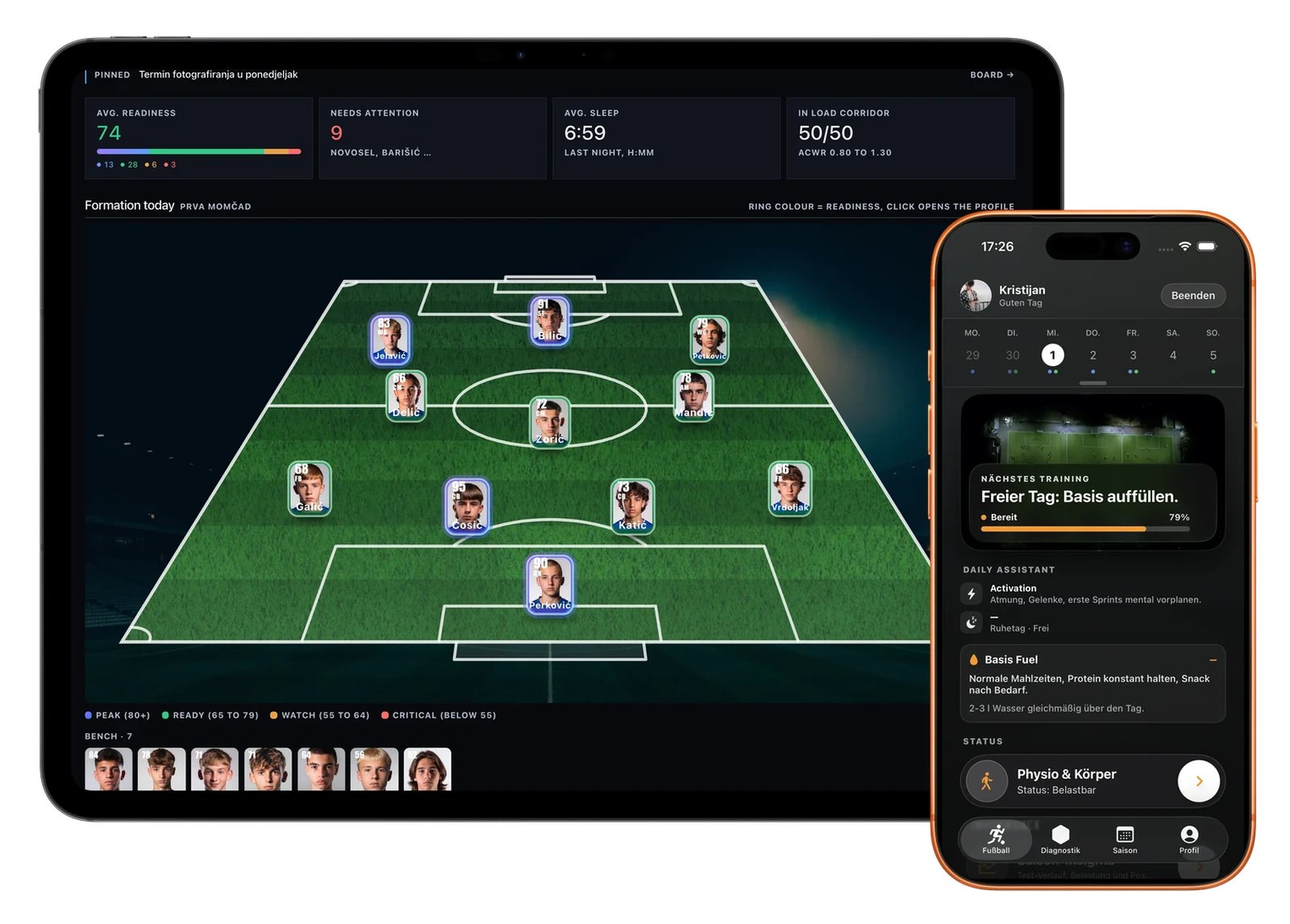
The realistic entry has three stages. Stage one: record session RPE after every session, collect for four weeks, judge nothing, so a baseline forms. Stage two: look at the weekly load per player and react only to spikes. Stage three: add recovery values, from self-report to sports watch. The Gearstack team dashboard takes over the tedious part, the collecting and computing: players report in thirty seconds on the phone, watch data flows in automatically, and the coach sees weekly load, spikes and readiness of the whole squad on one page. The decisions stay with the coach, but they stand on numbers.
Common questions
- What is training management, in one sentence?
- The weekly feedback loop of three steps: record the load, check how players absorb it, and adjust the next week accordingly.
- Does an amateur club need GPS vests or a lab?
- No. Session RPE (effort times duration) is scientifically validated and free. GPS and lab diagnostics refine the picture but do not change the method. Sports watches that players wear anyway deliver the recovery side automatically.
- What is the most common mistake in practice?
- Load spikes after breaks: the first week after holidays, the training camp, the tournament week. The body absorbs high, familiar load well and fast increases badly. Returning in steps is the cheapest injury protection there is.
For clubs: Eleven players, eleven readiness scores
Sources
Gearstack Health
Your numbers in context
Gearstack Health turns HRV, sleep and training into a daily readiness view with clear next steps.
Gearstack Health is a wellness and prevention product, not a medical device. This text does not replace medical diagnosis, treatment or emergency care.
AI-assisted, reviewed by Kristijan Bezjak, founder of Gearstack.