
Autoregulation means matching planned load to your actual state. It sounds sensible and often goes wrong in practice, because every mediocre value turns into an excuse. This guide draws the line.
Autoregulation instead of a rigid plan
A training plan is an assumption about how you will feel in three weeks. That assumption is routinely wrong, because sleep, work, infections and travel get in the way. Autoregulation replaces the fixed prescription with a range: the session happens, but intensity or volume move inside a corridor. The structure survives and the body still gets a vote. What autoregulation explicitly does not mean is deleting the session.
What a good day allows
If HRV and resting heart rate sit in your usual range and sleep was decent, that is a day for the hard session. That is exactly when the hard session should happen, because good days are the capital of your progress. A common mistake is staying conservative on good values and then trying to make up the missed work on bad days. That inverts the logic. Push clearly on good days and hold back on poor ones, not the other way around.
What a bad day means
A poor value usually means less intensity, not no movement. Hard intervals become an easy steady run. Five heavy sets become three moderate ones. For most people easy training supports recovery better than the sofa, because circulation and sleep pressure both benefit. Skipping entirely is the right call with fever, acute illness, pain, and after very short nights that coincide with a clearly elevated resting heart rate.
The danger of permanent caution
Anyone checking a number daily will almost always find a reason to take it easy. Over weeks that produces a training stimulus too small to do anything, and paradoxically the recovery values then fall as well, because aerobic base declines. A low value is not a prohibition. It is one piece of information sitting next to sleep, schedule, weather and motivation. You make the decision, not the app.
How to keep the plan flexible
What works in practice is planning in weeks rather than days. Decide how many hard sessions and how much total volume the week should hold, and move things inside the week according to state. If a hard session falls out on Tuesday it slides to Wednesday instead of disappearing. A subjective rating of effort after each session helps as well. If the same load feels progressively harder across two weeks, that says more than any score.
When to ignore the number
Before a race you are starting anyway, a poor morning value produces nothing but doubt. After travel, in serious heat and during the first week with a new watch, the data is unreliable. And when you feel thoroughly good while the app says otherwise, your perception takes priority. The values are a supporting instrument. They replace neither experience nor what your body tells you directly.
Common questions
- Should I take a full rest day when readiness is poor?
- Only with fever, acute illness, pain, or when short sleep and a clearly elevated resting heart rate coincide. In every other case a reduced session is the better choice, because easy movement tends to support recovery more than rest does.
- How many hard sessions per week make sense?
- For most recreational athletes two to three, spread across the week with at least one calm day between them. More hard days only pay off if sleep and nutrition keep up over the long run.
- My values are good but I feel terrible. Which wins?
- Your perception. The values reflect the autonomic nervous system, not muscle soreness, motivation or an injury coming on. If the two keep diverging, it is worth a closer look at nutrition, stress and possibly a conversation with a doctor.
For clubs: Eleven players, eleven readiness scores
Sources
Gearstack Health
Your numbers in context
Gearstack Health turns HRV, sleep and training into a daily readiness view with clear next steps.
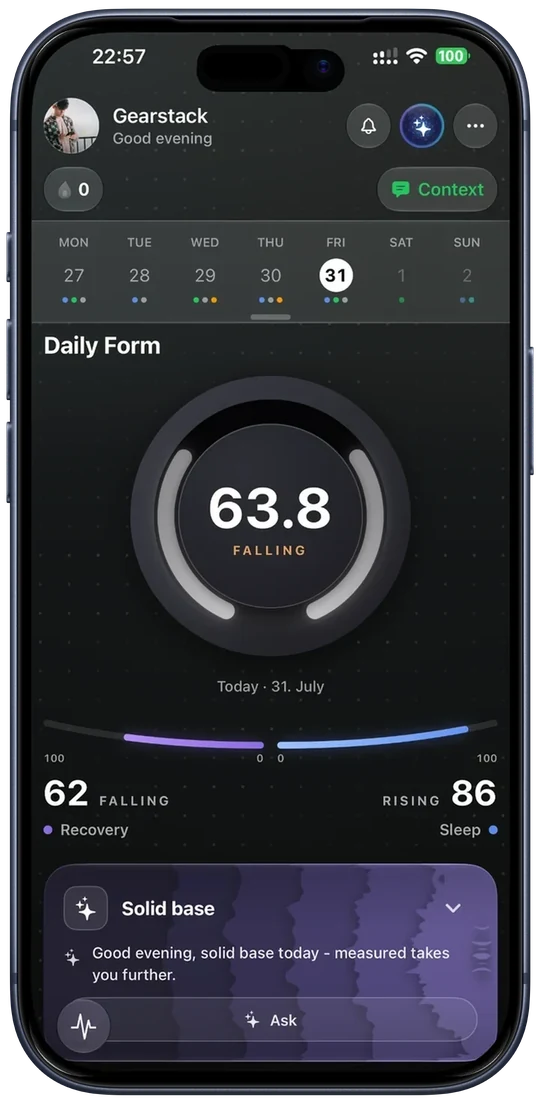
Gearstack Health is a wellness and prevention product, not a medical device. This text does not replace medical diagnosis, treatment or emergency care.
AI-assisted, reviewed by Kristijan Bezjak, founder of Gearstack.