
Every coach knows the match where the best player surprisingly wins no duels. Afterwards it turns out: barely slept, sick during the week or three days of exam stress. The information existed at ten in the morning on matchday, it just never reached the coach. Day-to-day form is measurable, and measurable before the line-up is written.
What readiness is, in three ingredients
Day-to-day form sounds like a mystery but consists of three measurable ingredients. First, the sleep of the last night and the nights before, in duration and quality. Second, the state of the autonomic nervous system, readable in morning heart rate variability and resting heart rate: a body under residual load shows a suppressed HRV and an elevated pulse. Third, the load of the previous days, because a hard Thursday session is still in the legs on Saturday. All three ingredients are available on the morning of the match, either from a sports watch or from a short self-report by the player.
The own normal range beats every table
An HRV of 55 milliseconds alone says nothing, because differences of factor three between players are normal. The value becomes meaningful only against the player’s own normal range of the past weeks. If a player sits clearly below his usual band for two or three days in a row, he is carrying something: an infection, a sleep deficit, stress or simply too much training. Exactly this comparison is what a readiness score computes, the way Gearstack builds it for every player: one number that sets HRV, resting heart rate and sleep against the personal baseline.
What readiness decides on matchday, and what not
The honest answer: it rarely decides the starting eleven. A leader with a mediocre morning value starts anyway when it matters. Readiness decides the questions behind it, and there are more of those. Which of two equal candidates begins. Who comes off after sixty minutes, before tired legs lead to the mistake. For whom the running-intensive wing is too much today and who plays centrally instead. And with youth players in a growth phase: who better not play ninety minutes today. For all of that the coach needs the information before kick-off; the warm-up impression comes too late.
Self-report beats silence: the four-question ritual
Without watches the principle works too, with four questions in the morning: how did you sleep, how heavy do the legs feel, how is your mood, do you have pain anywhere. Each on a scale from one to seven, answered in thirty seconds on the phone. This short form of the so-called Hooper index correlates surprisingly well with the actual state in studies, often better than single measurements. The point is regularity: a single morning says little, a pattern over weeks says a lot. And players answer honestly as long as a bad report does not automatically mean the bench.
The squad overview on the morning of the match
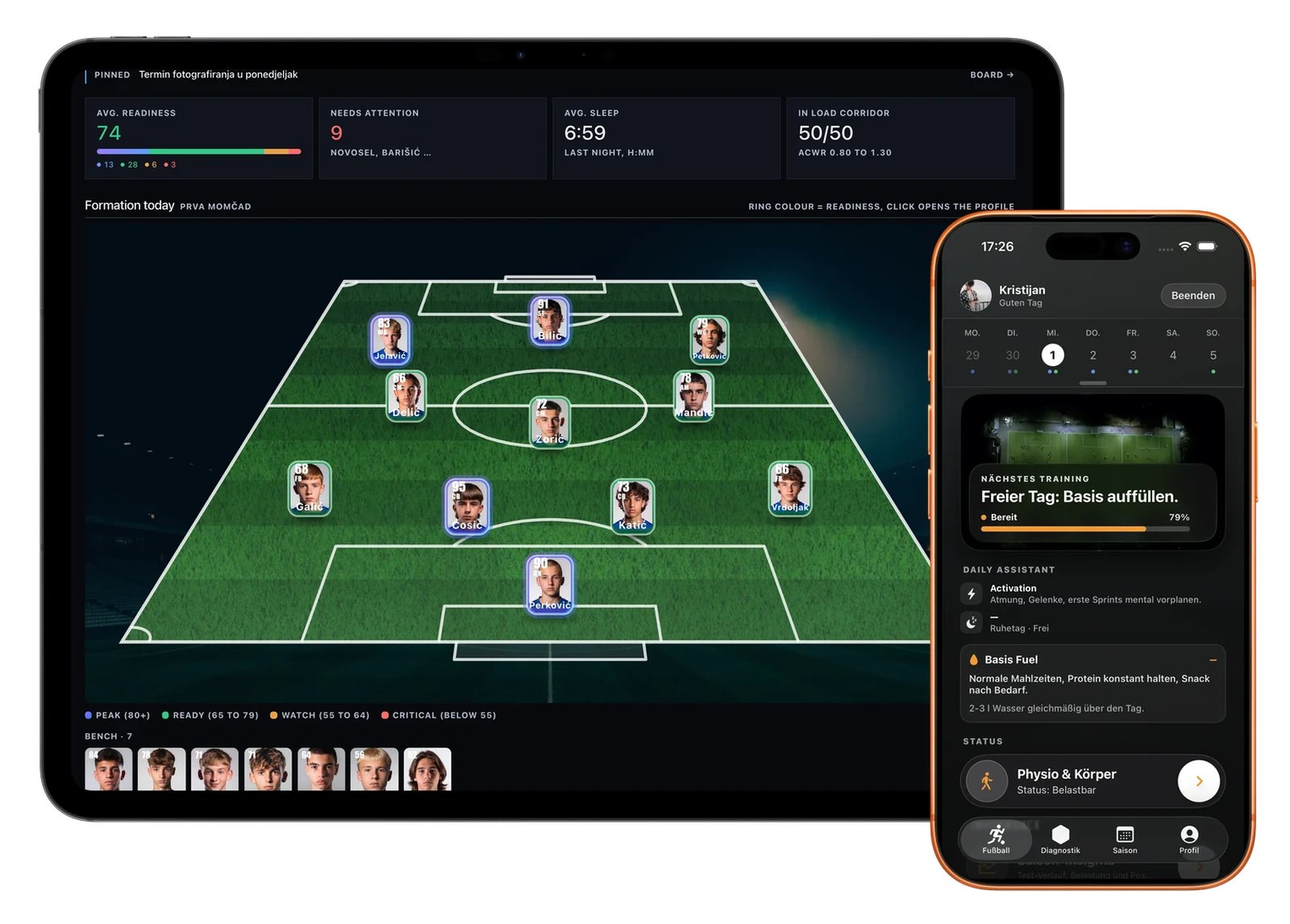
All of this becomes practical only when the squad’s values sit on one page. In the Gearstack team dashboard the coach sees every player on Saturday morning with his readiness score against his own baseline, sorted by conspicuousness: at the top the two or three players whose values have been suppressed for days, below them the green rest. Next to it the load of the week, so a bad value can be put into context. The look takes one coffee and replaces no conversation, it only says who the conversation should happen with today. The line-up is still written by the coach.
Common questions
- Can you judge readiness without a sports watch?
- Yes, with a short morning self-report: sleep, heavy legs, mood and pain rated on a scale. This approach is validated as the Hooper index and takes under a minute. Watches refine the picture with HRV, resting heart rate and sleep data.
- Which value shows readiness most reliably?
- No single one. Most robust is the combination of heart rate variability and resting heart rate compared with the player’s own normal range, complemented by sleep and the load of the previous days. A readiness score bundles exactly these variables into one number.
- Should the line-up depend on measurements?
- Not as the sole basis. The values show which players need attention today and support decisions about minutes, position and substitutions. The line-up itself remains a coaching decision with more factors than physiology.
For clubs: Eleven players, eleven readiness scores
Sources
Gearstack Health
Your numbers in context
Gearstack Health turns HRV, sleep and training into a daily readiness view with clear next steps.
Gearstack Health is a wellness and prevention product, not a medical device. This text does not replace medical diagnosis, treatment or emergency care.
AI-assisted, reviewed by Kristijan Bezjak, founder of Gearstack.