
A smartwatch can measure changes in the body and use them to estimate a stress score. It cannot automatically know whether the cause was a difficult conversation, interval training, poor sleep, alcohol, or an emerging illness. The number describes a modelled physiological stress response, not a mental-health diagnosis. It becomes useful when you consider measurement quality, your personal pattern, and the context of the day together.
The watch measures a response, not its cause
Depending on the device, stress algorithms may use heart rate, beat-to-beat intervals, movement, and sometimes skin conductance or temperature. They estimate whether your body appears more activated. That activation is not automatically harmful: exercise, excitement, heat, or focused work can produce signals similar to distress. In the other direction, a difficult experience can feel intense without appearing clearly in one short measurement window. Treat the score as evidence of a possible physiological response. Its meaning comes from asking what happened before, during, and after the reading.
Sensor quality depends on both signal and situation
One validation study tested a research wristband in 14 healthy participants during rest, emotional stimuli, and simulated driving. Time-domain HRV measures showed good reliability in several calmer conditions, while the electrodermal measures examined did not show corresponding correlation with the reference system. The small laboratory study cannot be applied to every watch, but it demonstrates an important limit: an algorithm cannot exceed the quality of its inputs. Movement, a loose fit, cold skin, tattoos, sweat, and missing samples can further affect wrist measurements.
Good individual signals still do not guarantee a perfect score
A prospective study compared 316 readings from Apple Watch Series 9 and Ultra 2 in 39 healthy adults with a chest-strap reference system. Resting heart rate agreed closely, while HRV did not meet the prespecified equivalence margin and was underestimated on average. A more recent experiment with 60 participants found that a Garmin stress score changed between rest and laboratory stress, but also highlighted the limited transparency of composite manufacturer scores. That does not make the number useless. It means that a personal trend with context is more defensible than treating one precise-looking output as fact.
Check the measurement, then the pattern, then the context
When a reading looks unusual, ask three questions. First: was the measurement plausible, was the watch fitted properly, and were there gaps? Second: is this a one-day change or a pattern across several comparable days? Third: what factors line up with it, such as training, sleep, travel, alcohol, temperature, caffeine, illness symptoms, or emotional pressure? One brief note is often more valuable than repeatedly checking the score every few minutes. Compare similar times and situations where possible. This helps distinguish random variation from a recurring pattern without turning either into a diagnosis.
Turn the signal into one small, testable action
When the score and your own experience both suggest high load, choose an action whose effect you can observe: a quiet break, a walk, lower training intensity, regular food, or an earlier bedtime. Check later whether both how you feel and the wider trend return toward normal. Do not try to “breathe away” every rise or manufacture perfect stress numbers; normal activation is part of life. Persistent overwhelm, anxiety, sleep difficulty, or depressive symptoms deserve a conversation with a qualified professional. Chest pain, severe breathlessness, fainting, or an acute crisis require immediate professional help regardless of the watch reading.
Common questions
- Why does my watch show stress when I feel relaxed?
- Exercise, heat, caffeine, dehydration, poor sleep, or an emerging illness can also activate the body. Check the measurement conditions and the day’s context. One high score proves neither psychological stress nor disease.
- Can a normal stress score rule out psychological strain?
- No. Subjective experience and physiological measurements overlap, but they are not identical. If you feel persistently overwhelmed, anxious, or low, that experience is sufficient reason to seek support regardless of the score.
Sources
- The Validity of Apple Watch Series 9 and Ultra 2 for Serial Measurements of Heart Rate Variability and Resting Heart Rate
- Wrist-Worn Sensor Validation for Heart Rate Variability and Electrodermal Activity Detection in a Stressful Driving Environment
- Assessing Stress Level Scores Against Wearables-Driven Physiological Measurements
Gearstack Health
Add the context your stress score cannot see
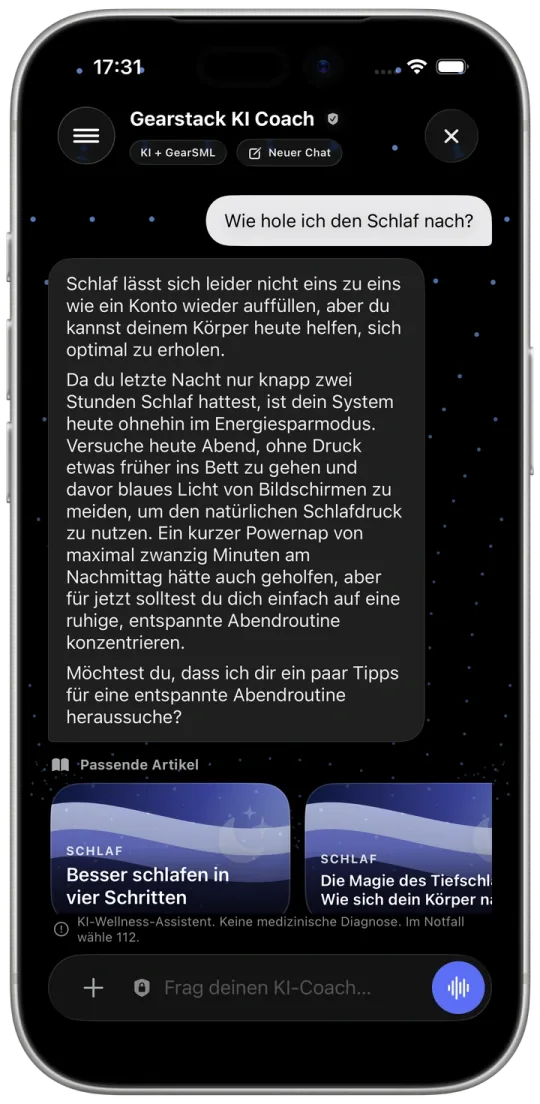
Gearstack connects HRV, resting heart rate, sleep, training, and your brief daily check-in, turning an isolated stress number into an understandable pattern with next steps.
Gearstack Health is a wellness and prevention product, not a medical device. This text does not replace medical diagnosis, treatment or emergency care.
AI-assisted, reviewed by Kristijan Bezjak, founder of Gearstack.