
After a few days off the legs get restless, and the question is always the same: can I go again? The usual answer is to listen to your body, which helps little when your body is exactly what you cannot read right now. There are two clear rules, and one of them has no exceptions.
The neck check as a first decision aid
Common in sport is the so-called neck check. If symptoms stay above the neck, meaning a runny nose, a mild scratchy throat, a blocked nose, little speaks against an easy session. If they sit below the neck, meaning cough, aching limbs, tightness in the chest, fever or feeling generally ill, resting is the right call. The rule is not a clinical guideline but a practical heuristic, and it catches the critical cases remarkably reliably.
Fever is the hard line
From thirty-eight degrees the rule holds without exception: no exercise. Not only during, but until at least twenty-four hours after the last temperature, without fever-reducing medication. The reason is not performance, it is the heart. In a febrile infection the pathogen can involve the heart muscle, and physical load in that phase is precisely the factor that turns a silent inflammation into a serious problem.
Why the heart is the real question
Myocarditis is rare, but it is the reason these rules sound so strict. It can cause arrhythmia and in the worst case sudden cardiac death, and it preferentially hits people who load too early. Warning signs are breathlessness at low effort, palpitations, pressure in the chest, unusual drops in performance, and a resting heart rate that stays clearly elevated for days after the infection. Each of those belongs with a doctor before training resumes.
What the return looks like
Building load in steps has proven better than picking up where you left off. A workable approach: one to two days at reduced intensity for every day of illness. The first session is easy and short, at a pace where speaking is effortless. If that passes without after-effects, duration comes before intensity. Hard intervals and races sit at the end of that sequence, not at the start.
What your numbers show
An infection leaves a clear trace: elevated resting heart rate across several nights, lowered heart rate variability, often worse sleep. The useful part is that this trace disappears before you feel fully fit again, or it does not. A resting heart rate still five to ten beats above your normal a week after the infection is a good reason to push the first hard session further back, even when your head feels ready.
The part that concerns the group
In teams and training groups pressure builds, because nobody wants to be the one sitting out. That is exactly why it pays to agree the rules in advance rather than negotiating case by case: no training with fever, no racing during the rebuild, and whoever sits out does not have to justify it. That takes the decision off the individual and protects the group from an infection working its way through the whole squad.
Common questions
- I only have a runny nose. Can I go for a run?
- Usually yes, easy and shorter than normal. If you notice that your usual pace feels unusually hard or your heart rate sits higher than normal, stop. That is not a setback, it is the information you were looking for.
- How long should I rest after flu?
- After a febrile infection one to two quiet weeks from the last day of fever is common, with a stepwise build-up. The exact period depends on the course of the illness, so with a severe course or lasting symptoms a medical assessment makes sense.
- Does training weaken the immune system?
- Moderate movement does not, it tends to help. Very hard and long sessions do open a window of raised susceptibility. In a period with many infections around you it is therefore sensible to space out the hardest sessions.
Sources
Gearstack Health
Your numbers in context
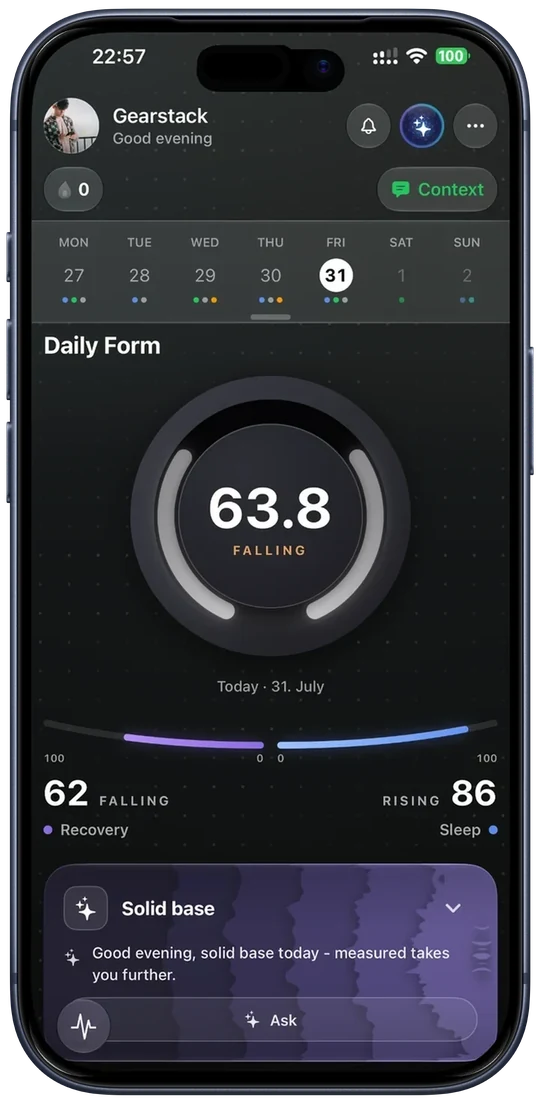
Gearstack Health turns HRV, sleep and training into a daily readiness view with clear next steps.
Gearstack Health is a wellness and prevention product, not a medical device. This text does not replace medical diagnosis, treatment or emergency care.
AI-assisted, reviewed by Kristijan Bezjak, founder of Gearstack.