
Ten thousand steps sit in almost every fitness app, and hardly anyone knows where the figure came from. The answer is awkward: an advertising campaign. What analyses of hundreds of thousands of people show looks different and is far easier to reach for most. This guide puts the number in context and explains why it accumulates almost by itself in company.
Where the 10,000 came from
The figure traces back to a Japanese pedometer from the 1960s marketed as manpo-kei, literally ten-thousand-step meter. The name was catchy, the character for ten thousand looked like a walking person, and the number stuck. No study established that particular threshold at the time. It is not a medical cut-off, it is the most successful advertising slogan in the history of movement.
What large analyses show
Syntheses of several large cohorts trace a curve that falls steeply early and then flattens. The lowest mortality risk sits roughly between seven and nine thousand steps a day. Moving from two thousand to seven thousand improves outcomes markedly across a whole range of health measures. Above that band the line keeps improving, but the gain per additional thousand steps keeps shrinking. The big jump is at the start, not at the end.
Age shifts the band
In people over sixty the curve flattens earlier, with the favourable band closer to six to eight thousand steps. Under sixty it moves up, roughly to eight to ten thousand. That is the one sensible core of the famous number: for younger adults it does sit near the optimal band, while for older adults it sets a target that is unnecessarily high and more likely to discourage than to help.
Why the count alone is not enough
Steps measure quantity, not effort. Ten thousand slow steps spread across a day act differently than six thousand with twenty brisk minutes inside them. Analyses show that pace contributes on its own, independent of the total. If time is short, a brisk walk returns more than many small errands at a stroll. And standing rather than sitting will not improve your step count, though it will improve your day.
Why it adds up more easily with someone
The number itself motivates almost nobody across weeks. Appointments do. A fixed time with another person holds better than any daily target, because cancelling then costs a negotiation instead of a tap. The same goes for shared routes: walking to work with a colleague, the Saturday trip to the market, taking the call on foot instead of at the desk. Attach steps to social commitments you already have and you stop having to talk yourself into it every day.
What to actually aim for
Instead of a round target, your own starting point is the better reference. Watch where you usually land for a week, then aim for two thousand more. For most that is a good half hour of walking, splittable across two or three occasions, and it sits exactly in the part of the curve where the return is largest. If it holds for three weeks, the next step up becomes a question of habit rather than discipline.
Common questions
- Do steps around the house count?
- Yes, every step goes into the total. For heart and circulation a continuous brisk stretch adds something that many short trips do not deliver. The two are not exclusive: one is the base, the other is the stimulus.
- My tracker and my phone report different counts. Which is right?
- Both are in range, they simply count differently. The phone records nothing while it sits on a table, the watch sometimes counts arm movement. Use one source and read the trend rather than the absolute number.
- Do group step challenges actually help?
- For consistency yes, as long as they are built fairly. Comparing raw step counts favours people with an office job downtown over everyone else. Challenges scored on improvement against your own previous week last considerably longer.
Sources
Gearstack Health
Your numbers in context
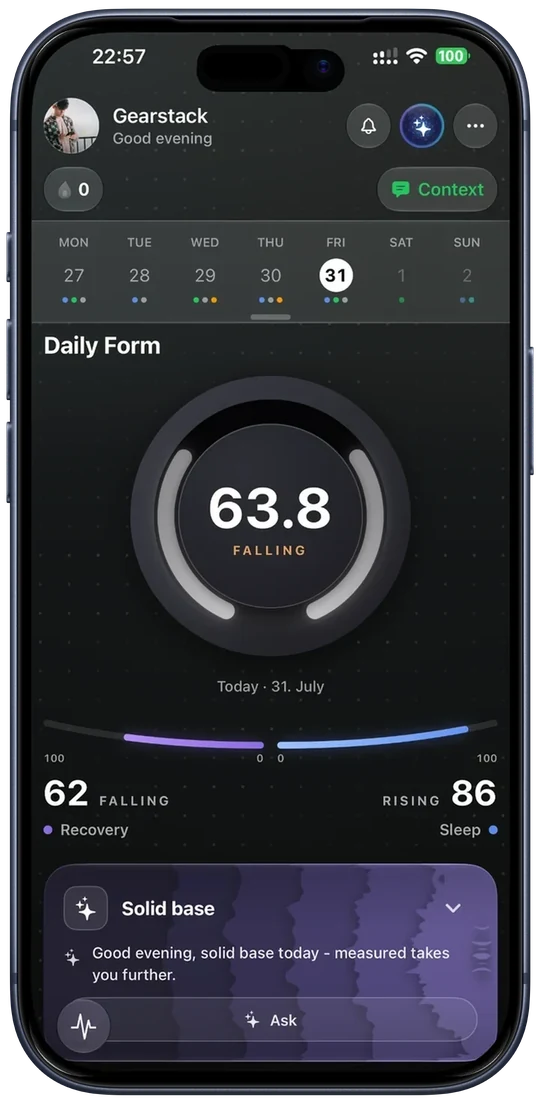
Gearstack Health turns HRV, sleep and training into a daily readiness view with clear next steps.
Gearstack Health is a wellness and prevention product, not a medical device. This text does not replace medical diagnosis, treatment or emergency care.
AI-assisted, reviewed by Kristijan Bezjak, founder of Gearstack.