
The hardest conversation in youth football rarely happens in the dressing room. It happens at the touchline, after the final whistle, when a father wants to know why his son played only twenty minutes. Coaches almost never lose these conversations because of their decisions. They lose them because they hold nothing but their impression, and against parental impressions the impression of a stranger is powerless.
Why these conversations escalate
Parents watch their child with the sharpest and most partial eye there is, and they see only a slice: the weekend match, never the training during the week. The coach argues from memory, and memories cannot be verified, so they cannot be shared either. Two impressions stand against each other, and the argument drifts to where it does not belong: the question of who knows the child better. That question a coach can only lose.
The shift from judgement to trajectory
The conversation turns the moment it stops being about a judgement and starts being about a trajectory. A sentence like “he often loses focus in training” is an attack on the child and gets defended as one. A trajectory like “he attended 14 of 16 sessions, his weekly load is stable, his running values have improved four percent since June, and that is exactly why his minutes are now increasing step by step” is a shared observation. Observations can be discussed; judgements can only be fought over.
The three data points that belong in the meeting
First, attendance, because it is the foundation of all development and contains the most common uncomfortable truth. Second, the load trajectory of recent weeks from the player’s own training reports, because it shows whether the child is building, stagnating or overloaded, say after a tournament week. Third, the trend values against his own base, the way a team dashboard computes them per player: if he runs further at the same heart rate than eight weeks ago, his recovery has stabilised. All of it is neutral, verifiable and about the child, never about comparison with other children.
The frame: fixed meetings instead of the touchline
Data only helps inside the right frame. What has proven itself: two fixed development meetings per season, announced at the start, fifteen minutes each, with the trajectory as the basis and the player at the table from a certain age. The side effect is the real win: whoever knows a November meeting with real numbers is coming does not have to corner the coach at the fence in October. For the touchline one rule remains, friendly and firm: individual decisions are discussed at the meeting, not after the whistle.
The limit: what data must not do in a parent meeting
Two traps remain. The first: data as a weapon. Whoever pulls out the trajectory only to refute parents has misunderstood the tool; the trajectory belongs on the table just as much when it speaks for the child and against the minutes given so far. The second: numbers as a substitute for the coach’s judgement. Game understanding, courage and behaviour in the group appear in no dashboard, and a meeting made only of curves is as empty as one made only of opinions. The data grounds the judgement, it does not replace it. Throughout, one rule stands: a child’s health data belongs to the parents and the child, and only what has been consented to is shared.
Common questions
- Should parents be able to see their child’s data?
- Yes. For minors, parental consent is the precondition of collection anyway. Transparency strengthens the meeting: parents who can see the trajectory themselves arrive with questions instead of accusations.
- What about parents who doubt every number?
- Point to the origin: the load is reported by the player himself, the trend values come from his own watch, and he is compared only with himself. Once the method is calmly explained, few keep attacking; those who do would have attacked without numbers too.
- Do comparisons with other players belong in the meeting?
- No. Same-age comparison mostly measures physical early development and produces only losers. The meeting is about the child against the child of eight weeks ago; where a squad decision is due, the decision is explained, not the teammate rated.
For clubs: Eleven players, eleven readiness scores
Sources
Gearstack Health
Your numbers in context
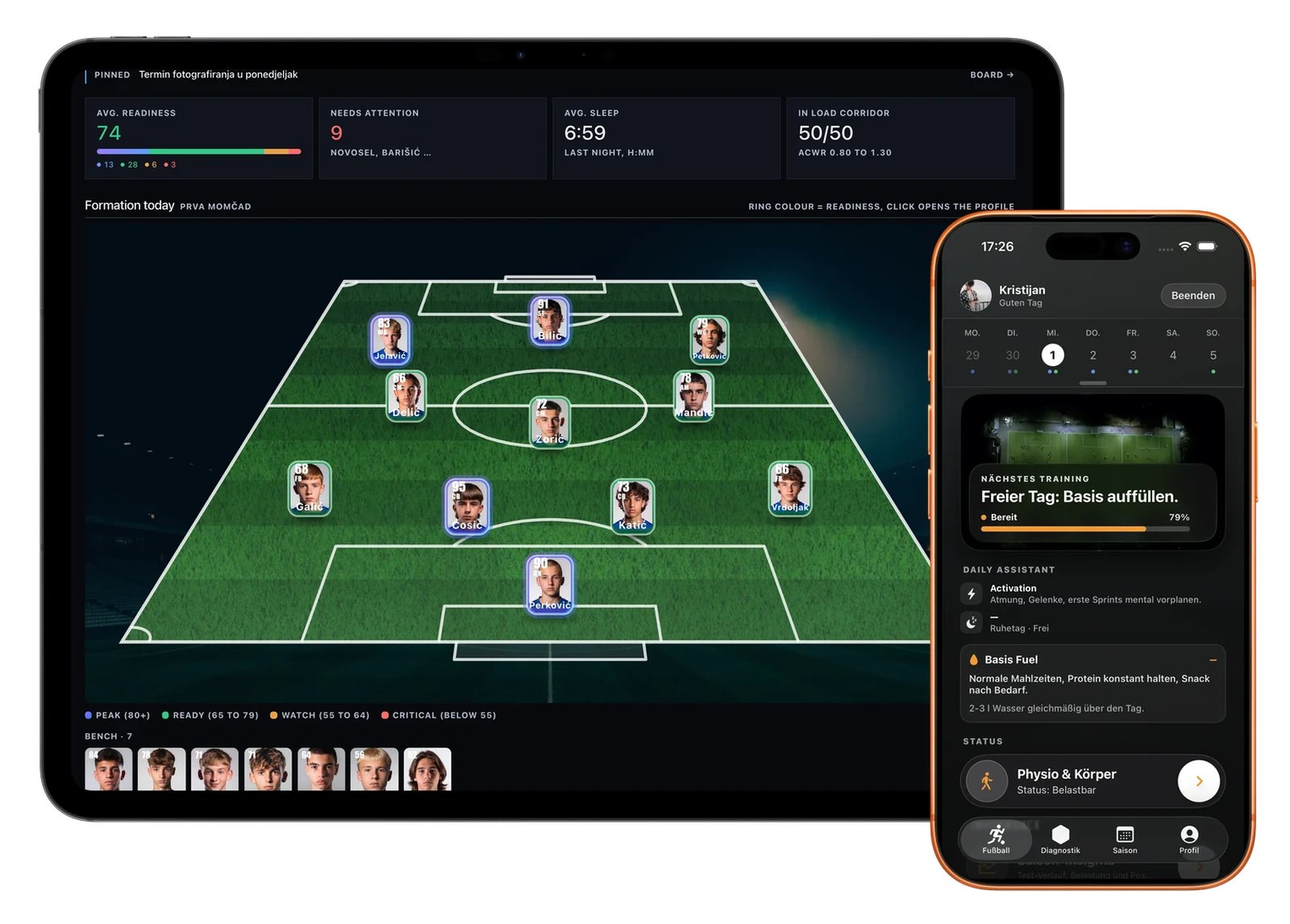
Gearstack Health turns HRV, sleep and training into a daily readiness view with clear next steps.
Gearstack Health is a wellness and prevention product, not a medical device. This text does not replace medical diagnosis, treatment or emergency care.
AI-assisted, reviewed by Kristijan Bezjak, founder of Gearstack.