In a heatwave week, many sleep records tell the same story: asleep later, awake more often, less deep sleep, and morning recovery numbers that look like the end of a hard week. Behind it sits measurable physiology. Core body temperature has to drop slightly for sleep to begin, and a heated-up bedroom makes exactly that difficult. Understanding what happens lets you counter it deliberately and judge the numbers of such nights fairly.
Why warmth slows down falling asleep
In the evening the body sheds heat through hands and feet, core temperature drifts slightly downward, and that drop is one of the strongest sleep signals there is. If the environment is too warm or too humid, heat loss works poorly, the signal is delayed, and the night starts later and more restless. Research reviews on heat and sleep show a clear pattern under realistic conditions with bedding and sleepwear: heat increases wakefulness and reduces deep and REM sleep. Cold disturbs sleep far less by comparison, because blankets defend against it better than anything defends against warmth.
What sensor studies measure in real bedrooms
The effect is not confined to the lab. In one study, 30 adults in Houston wore sensors for two weeks that also captured personal ambient temperature: as temperature rose, sleep efficiency fell, and air conditioning softened the effect. Among older adults whose bedrooms were tracked with temperature sensors over months, sleep was most efficient in a band of roughly 20 to 25 degrees Celsius and measurably worse with each additional degree above it. These are cohort findings rather than a target for every individual. They do show how strongly a few degrees in the bedroom shape the night.
Heart rate and HRV carry the warm night too
Thermoregulation is circulatory work. In warm nights the skin stays more strongly perfused, the heart works harder, and observational bedroom data shows shifted nocturnal heart activity at higher temperatures, with higher heart rate and lower HRV. Your morning values after a tropical night therefore often look like the aftermath of a late training session, even though all you did was sleep. That is the expected physiology of a warm night and not a warning sign by itself, as long as the numbers return to their usual lane once things cool down.
Cooling that actually works
The strongest lever is the bedroom itself: darken it during the day and keep windows closed while it is warmer outside than inside, then cross-ventilate as soon as the evening air turns cooler. A fan helps twice, through airflow across the skin and by moving night air through the room; air conditioning, where available, takes the edge off the night. On the body side, light bedding beats a heavy duvet, and a lukewarm shower before bed opens the skin vessels and supports heat loss. An ice-cold shower tends to do the opposite, because vessels constrict and heat stays trapped inside. Heavy late meals and alcohol hand the warm night extra work.
Reading a heatwave week fairly
A heatwave is an external factor that pushes all recovery numbers down at once, with no involvement of your training or routines. Treat such nights as noted context: lower expectations for hard sessions a little, steer load more by feel and daily readiness, and do not read the comparison with cooler weeks as regression. The interesting part comes after the heat: if sleep, resting heart rate and HRV normalize within a few cooler nights, it was the temperature. If the numbers stay suppressed beyond that, or symptoms such as dizziness, racing heart or marked exhaustion appear, that is a case for medical advice rather than data interpretation.
Common questions
- What is the ideal bedroom temperature?
- There is no exact number for everyone, and the study ranges come from cohorts, not from your bedroom. A rather cool band around the low twenties Celsius is a reasonable orientation; more important than the number is that your body can shed heat at night, through moving air, light covers and free feet.
- Is sleeping with a fan all night unhealthy?
- For most people a fan is unproblematic, and the airflow noticeably helps heat loss. Some react to a direct draft with dry eyes, a dry throat or a stiff neck. In that case aim the fan indirectly or let it circulate the room air instead of pointing it straight at the bed.
Sources
Gearstack Health
See what the heat does to your nights
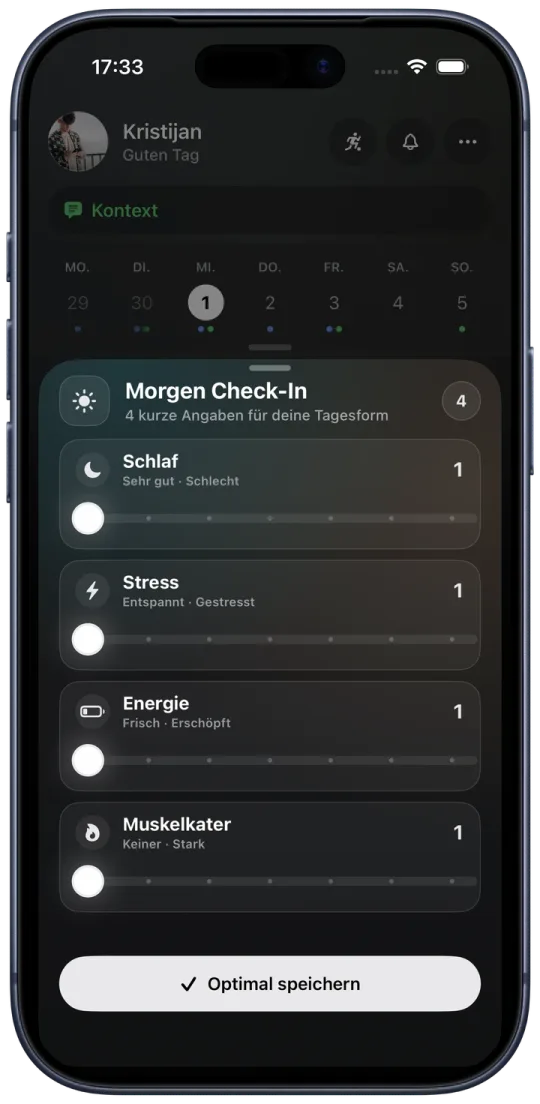
Gearstack shows sleep, resting heart rate and HRV as one trend, so you can read heat spells for what they are: context that passes.
Gearstack Health is a wellness and prevention product, not a medical device. This text does not replace medical diagnosis, treatment or emergency care.
AI-assisted, reviewed by Kristijan Bezjak, founder of Gearstack.