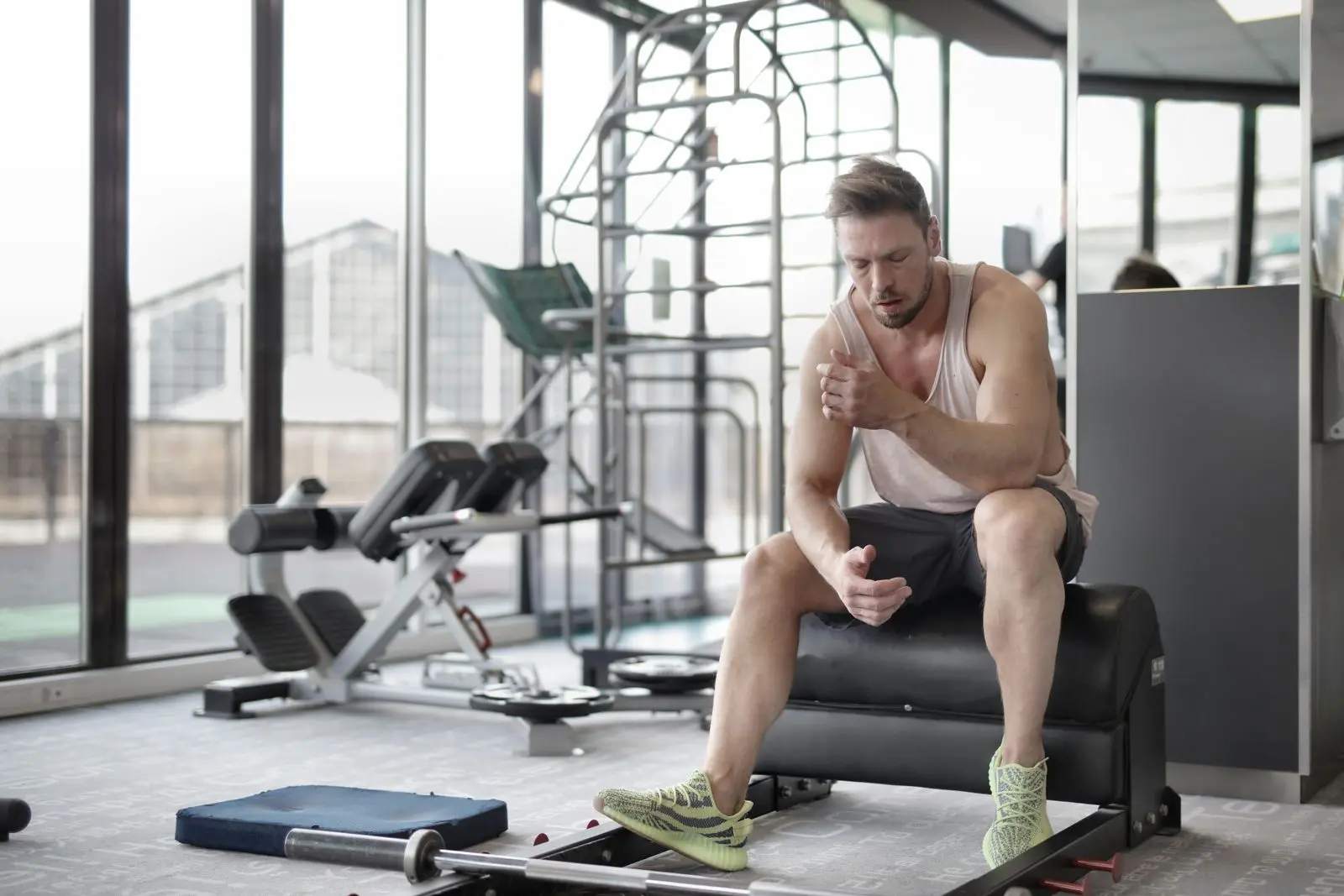
The question of how long to rest between sessions rarely gets an honest answer, because the usual forty-eight hour rule of thumb blends two very different things. The muscle is done sooner than most people think. The nervous system and the tendons take longer. This guide separates the two and names the signs that recovery is actually complete.
What happens in the muscle afterwards
A strength session leaves small damage in the muscle fibres and drains energy stores. The body answers with an elevated rate of muscle protein synthesis, the assembly of new building blocks. That rate climbs within hours, holds for roughly twenty-four to forty-eight hours in trained people, and runs up to seventy-two hours in the untrained or after unfamiliar movements. The gain happens inside that window, not during the session. It is also why a second session before the process finishes adds little.
Why the number varies so much
Four factors move the window substantially. Training state first: years of lifting means faster recovery from identical work. Volume second: five hard sets demand longer than two moderate ones. Third the type of loading, where braking movements create far more micro damage than accelerating ones. Fourth the size of the muscle group, since legs and back tax the whole system more than arms. That is how the same person can need one day for biceps and four for squats.
Soreness is not a measurement
Delayed onset muscle soreness typically starts twelve to twenty-four hours after the session, peaks after one to three days and clears within a week at most. It signals that an unfamiliar load happened, not that the load was good and not that the muscle is unfit to work again. Training without soreness does not mean you did too little. Having soreness does not require a rest day, as long as the movement stays clean and strength does not clearly drop.
The nervous system takes longer than the muscle
After heavy sets near your maximum the limiting factor is not the fibre but your ability to recruit it. This central fatigue often outlasts the soreness after very intense work and shows up differently: movement feels sluggish, technique degrades earlier, the familiar load feels heavier although nothing hurts. Tendons and ligaments also adapt far more slowly than muscle, which is the most common reason complaints appear only after weeks of rising volume.
How to tell recovery is done
Three signs together carry more weight than any hour count. Strength in the first working set is back at its usual level. Range of motion is back, you reach full depth without compensating. And morning resting heart rate sits where it usually does. If heart rate variability has also returned to your baseline, the case is clear. If one of those is clearly off, a lighter session beats a skipped one.
What actually speeds recovery up
The order is unglamorous and well supported. Sleep leads by a distance, because most repair runs at night. Then enough protein spread across the day and enough total energy, since a deficit slows rebuilding. Then light movement the day after, which raises blood flow without adding damage. Everything else, from ice baths to compression, works on how you feel at best, and cold straight after a session can even blunt the growth signal.
Common questions
- Can I train while sore?
- If the movement stays clean and strength does not clearly drop, there is no reason not to. A lighter session for the same muscle group often improves how it feels. That does not apply to sharp pain or restricted range of motion.
- How often per week can I train the same muscle group?
- Two sessions per muscle group per week works well for most people, because it reopens the growth window regularly. The key is that volume per session is lower than it would be training once a week.
- Does my recovery score tell me whether I can lift today?
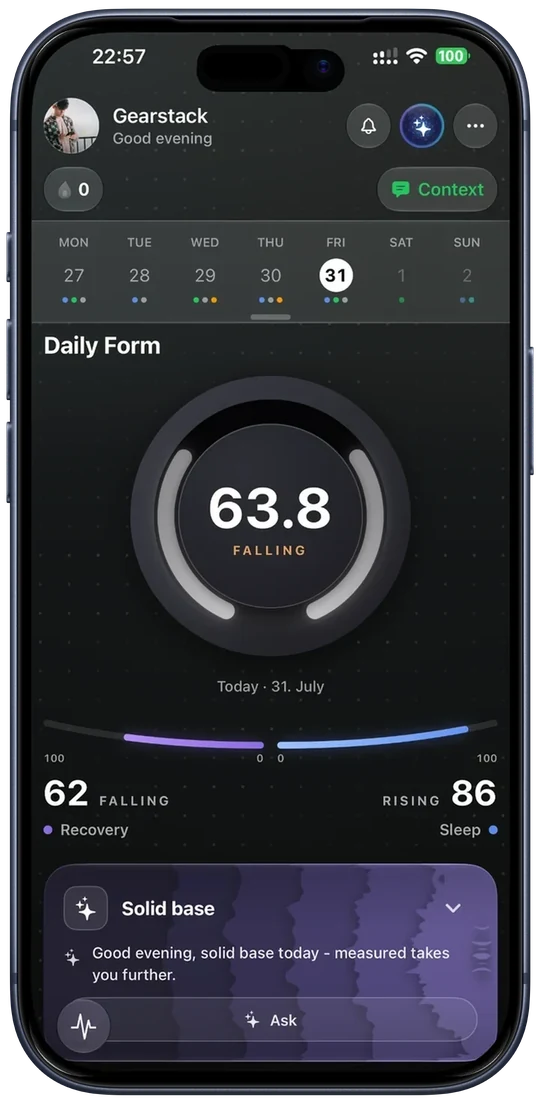
- It tells you how your system as a whole is doing, which is half the answer. The local state of the muscle group you trained last is not in there. The two together, the morning value and strength in your first set, give you a usable picture.
Sources
Gearstack Health
Your numbers in context
Gearstack Health turns HRV, sleep and training into a daily readiness view with clear next steps.
Gearstack Health is a wellness and prevention product, not a medical device. This text does not replace medical diagnosis, treatment or emergency care.
AI-assisted, reviewed by Kristijan Bezjak, founder of Gearstack.