
An AI coach is not a doctor and not a trainer. It is a translator: it takes numbers that mean nothing to you and turns them into sentences you can act on. That is less than the marketing promises and more than sceptics expect.
What it actually does
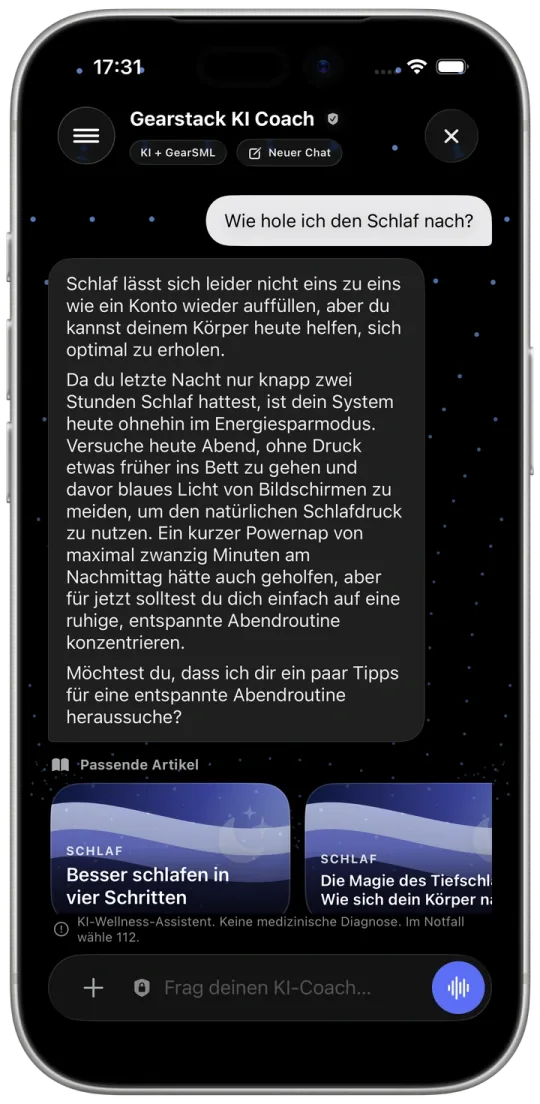
The real value sits in bringing things together. Your watch measures sleep, HRV, resting heart rate, steps, training. Those values live in different views, in different units, on different time axes. A person who can work with that needs practice and time. A language model with access to the data can summarise it in a paragraph and draw the connection that gets lost between charts. That is the core capability, and it is underrated.
Where it is strong
Three things it does well. First, context: it tells you whether a value is unusual for you without you having to hold your own statistics in your head. Second, relationships over time: it notices that your poor nights follow late sessions suspiciously often. Third, availability: it answers at eleven at night when a question occurs to you, and for people without a support team that is the practical difference.
What it necessarily fails at
It does not know the cause. It sees that your HRV dropped, but not whether that was alcohol, an argument, an infection coming on or a room that was too warm. It cannot examine you, cannot listen to your chest and cannot rule anything out. And it can be wrong: language models occasionally produce plausible-sounding but incorrect statements. With health questions that is not an academic problem. So the rule is: anything that sounds like a diagnosis does not belong in a chat, it belongs in a clinic.
Why data access changes everything
A general language model can explain what HRV is. That is in any encyclopaedia. It gets interesting only when the model knows your last thirty nights and can say that your current value sits in the lower quarter of your own range and that this last happened six weeks ago. No generic model can make that statement. It is also the reason it makes sense to build a coach into a health app at all rather than just opening a chat app.
What you should not ask it
Not for diagnoses, not about medication, not for an assessment of symptoms that worry you. Chest pain, shortness of breath, persistent dizziness, unexplained weight loss: all of that belongs to a doctor, immediately and without a detour through an app. During pregnancy, with chronic conditions and while taking medication, general training and nutrition advice should also be treated with caution. A good coach says so itself and declines rather than guesses.
How to get useful answers
Ask specifically and in context. Instead of "how can I sleep better", try "my sleep efficiency dropped this week, what changed in my data". Instead of "should I train today", try "I have a long run planned tomorrow, what does my load over the last seven days look like". The more a question ties to your actual values, the less generic advice comes back. And if an answer sounds too certain, ask what it is based on.
Common questions
- Can an AI coach replace a personal trainer?
- Not for technique correction, individual periodisation or judging movement quality. For putting values in context, reminders and the question of whether today is a good day for load, it can cover a large part.
- How do I know whether an answer is right?
- Check whether it refers to concrete values from your data or only sounds general. Answers with numbers from your own history are verifiable. General advice with no reference is textbook knowledge at best.
- Is my health data safe in this?
- That depends on the provider and is a question worth settling before you use it. What matters: where the data sits, whether it is transmitted pseudonymised, whether it is used to train models, and whether you can delete it completely.
Sources
Gearstack Health
Your numbers in context
Gearstack Health turns HRV, sleep and training into a daily readiness view with clear next steps.
Gearstack Health is a wellness and prevention product, not a medical device. This text does not replace medical diagnosis, treatment or emergency care.
AI-assisted, reviewed by Kristijan Bezjak, founder of Gearstack.