
Deliberately training less for a week feels like a step backward to many people, especially when progress has just become visible. Yet the deload is one of the oldest tools in program design: a short phase of reduced load that clears accumulated fatigue before it settles into grinding sessions, worse sleep or nagging aches. The fear of losing muscle or strength in that week has been studied properly by now, and it is largely unfounded.
What a deload is and what it is not
A deload is a planned phase, usually about a week, in which volume, load or effort is clearly reduced to shed physical and mental fatigue and prepare the next training block. It differs from tapering, which builds specifically toward a competition, and from a forced break due to illness or injury. The defining feature is the planning: a deload belongs in the training rhythm from the start, like any other building block.
The fear of losing gains does not survive the data
In a controlled study, two groups trained identically for nine weeks, except that one group inserted a complete week without resistance training in the middle. At the end, researchers found no meaningful differences in muscle thickness or maximal strength between the groups. A newer randomized investigation of deload periods in novice lifters painted a similar picture for muscle growth and strength endurance. One week of reduced stimulus does not make the body discard what it built over months. What can feel heavier in the first days afterward is mostly re-familiarization with the movements, not lost tissue.
When a deload makes sense
In a survey, many strength and conditioning coaches schedule deloads regularly, often somewhere between four and eight training weeks apart, and adjust them to the state of their athletes on top. For your own training, both triggers work: the calendar and the signals. Signals include performance that stalls or drops across several sessions, a noticeably elevated resting heart rate or suppressed HRV over several days, sticky sleep, and motivation that feels like duty rather than appetite. One bad day is not a reason to deload; a pattern across one or two weeks is.
How to structure the week in practice
A proven approach is to roughly halve training volume, meaning fewer sets and sessions, while keeping the movements familiar. Loads can stay moderate but clearly below the limit of effort; no sets to failure, no new records. The freed-up time is easy to spend well: technique on the main lifts, mobility, easy aerobic work, walks, sleep. Endurance athletes reduce mileage and intensity in the same spirit and keep only short, easy sessions. By the end of the week a deload should have felt almost too easy. That is precisely its job.
What your recovery numbers do during a deload
Many expect HRV and readiness to jump upward immediately in a quiet week. Often that happens with a delay, sometimes only in the following week, once the body has finished its repair work. The opposite occurs too: the numbers stay unspectacular, but the first hard session after the deload runs noticeably better. So measure success not by a single score but by the week after: how the main lifts feel, how quickly you recover between sets, how the sleep looks. A deload is an investment whose return is paid out in the next block.
Common questions
- Will I lose muscle in a deload week?
- The available studies argue against it. After a week of reduced or paused resistance training, no meaningful differences in muscle thickness or strength appeared compared with training straight through. A temporarily flatter feeling in the muscles has more to do with glycogen and fluid stores and normalizes quickly.
- Deload or a complete week off, which is better?
- Both can work. A deload with light, familiar movements keeps routine and technique warm and is mentally easier for many than a full stop. A complete week off is no drama either, and is the natural choice when travel, illness or life forces it anyway. What matters is that the reduction is substantial and that you re-enter with structure afterward.
Sources
- Gaining more from doing less? The effects of a one-week deload period during supervised resistance training on muscular adaptations
- Effects of deload periods in resistance training on muscle hypertrophy and strength endurance in untrained young men
- Resistance training prescription during planned deloading periods: a survey of strength and conditioning coaches across varying sporting codes
Gearstack Health
Spot the week your body is asking for
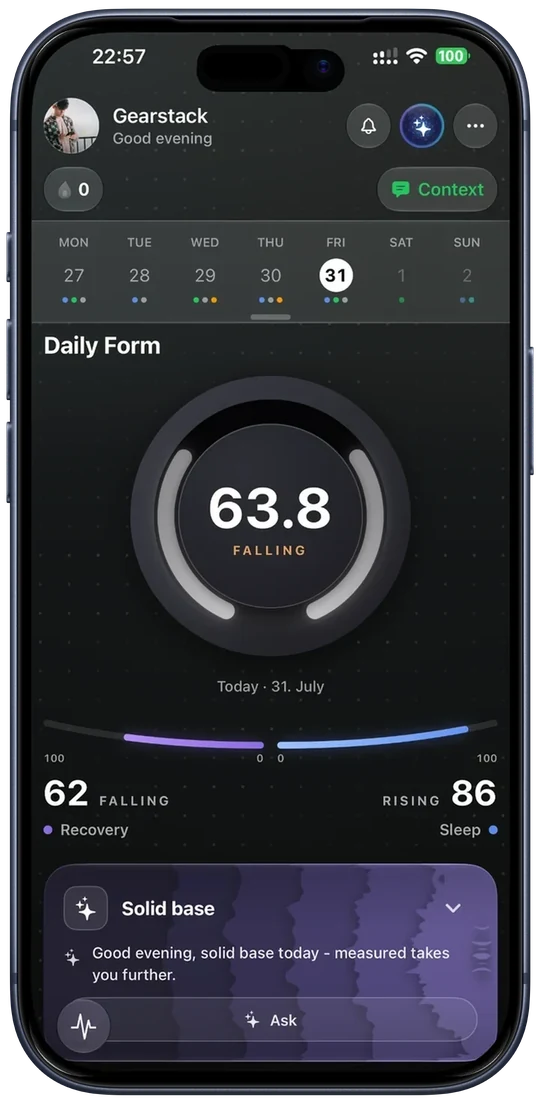
Gearstack links training load, HRV, sleep and daily readiness into one trend, so you can see fatigue building before it slows you down.
Gearstack Health is a wellness and prevention product, not a medical device. This text does not replace medical diagnosis, treatment or emergency care.
AI-assisted, reviewed by Kristijan Bezjak, founder of Gearstack.